Tesamorelin: The GHRH Analogue Behind Egrifta and Its Research
Tesamorelin is human GHRH(1-44) with an N-terminal hexenoyl group. Here is what the Egrifta approval covers, what the trials reported, and how it is classified in sport.
HOME / RESEARCH COMPOUNDS / TESAMORELIN
Lyophilised vial · supplied for laboratory research
Tesamorelin is a synthetic analogue of growth hormone-releasing hormone (GHRH): the full 44-amino-acid sequence of human GHRH with a hexenoyl group attached to the N-terminal tyrosine. It acts on GHRH receptors, one step upstream of growth hormone itself. Under the brand name Egrifta it is FDA-approved for a single, narrow indication.
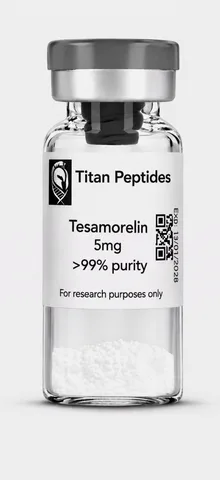
The tesamorelin sold here is not Egrifta. It is a lyophilised powder in a sealed 5 mg vial, supplied for laboratory research only and not for human or veterinary use. The summary below covers what the clinical and laboratory research has reported and how the compound is treated in Australia and in sport.
| Compound class | Synthetic growth hormone-releasing hormone (GHRH) analogue, 44 residues |
|---|---|
| Sequence (one-letter) | (E)-hex-3-enoyl-YADAIFTNSYRKVLGQLSARKLLQDIMSRQQGESNQERGARARL-NH2 (human GHRH(1-44) amide with an N-terminal hexenoyl group) |
| Molecular formula | C221H366N72O67S (free base, PubChem) |
| Molar mass | 5136 g/mol (PubChem); 5135.9 Da as free base (FDA label) |
| CAS number | 218949-48-5 |
| PubChem CID | 16137828 |
| Other names | TH9507; Egrifta is the US brand of the approved medicine |
| Supplied as | Lyophilised powder, sealed vial |
| Strength | 5 mg per vial |
| Storage (lyophilised) | Sealed, dry and dark at −20 °C or colder; −50 to −80 °C for long-term storage |
| Intended use | Laboratory research only |
According to the FDA label, tesamorelin binds and stimulates human GHRH receptors in vitro with potency similar to the endogenous hormone. Because it acts on the pituitary rather than replacing growth hormone, its downstream effects depend on an intact hypothalamic–pituitary axis.1
The large trials were in people with HIV on antiretroviral therapy, and none measured hard outcomes such as cardiovascular events. Our tesamorelin research overview covers the cognition studies and how tesamorelin differs from ipamorelin and CJC-1295, and peptides and the WADA Prohibited List shows how anti-doping rules group these compounds.
The FDA first approved Egrifta (tesamorelin) on 10 November 2010; the application is now BLA 022505.5 The current labels state one indication, reduction of excess abdominal fat in HIV-infected adults with lipodystrophy, and say it is not indicated for weight-loss management.1 That approval covers a specific finished product and does not extend to research-grade material. Tesamorelin is not named in the Poisons Standard June 2026 (F2026L00633).6 In sport, the 2026 WADA Prohibited List names tesamorelin in section S2.2.4, growth hormone releasing factors, prohibited at all times, even though it is the active ingredient of an approved medicine.7
Research-grade tesamorelin is not an approved medicine. See research peptides and Australian law.
Store the sealed vial dry, dark and frozen at −20 °C or colder (−50 to −80 °C for long-term storage), and let it reach room temperature in a desiccator before opening. The 44-residue sequence contains a methionine, which is prone to oxidation, and several asparagine and glutamine residues, which are prone to deamidation, so limit air exposure and keep solutions only briefly: aliquot a reconstituted stock into single-use tubes, freeze them and avoid freeze–thaw cycles. See how to store peptides and reconstituting peptides with bacteriostatic or sterile water for the reasoning behind each step.
No. Egrifta is an FDA-approved finished medicine, made and labelled under BLA 022505 for one indication in HIV-associated lipodystrophy. Research-grade tesamorelin is the same intended molecule supplied as a lyophilised 5 mg vial for laboratory use. It carries none of Egrifta's approval, is not an approved medicine and is not for human or veterinary use.
PubChem lists tesamorelin under CAS 218949-48-5 and CID 16137828, with the molecular formula C221H366N72O67S and a molar mass of 5136 g/mol; the FDA label gives 5135.9 Da as free base. Its development code was TH9507, which appears, for example, in the title of the 2010 pooled analysis of two phase 3 trials.
Not in the same sense. Tesamorelin is a GHRH analogue acting through the GHRH receptor. Ipamorelin is a five-residue growth hormone secretagogue that, in rat pituitary cell experiments, released growth hormone through a GHRP-like receptor rather than the GHRH receptor. The 2026 WADA Prohibited List reflects the difference by placing them in separate subgroups of section S2.2.4.
Tesamorelin is not named in the June 2026 Poisons Standard. Egrifta's FDA approval is a US decision covering that specific product and does not extend to research-grade material, which is not an approved medicine. Our guide to research peptides and Australian law explains how the Poisons Standard and the TGA's position on unapproved peptide products work.
Tesamorelin is human GHRH(1-44) with an N-terminal hexenoyl group. Here is what the Egrifta approval covers, what the trials reported, and how it is classified in sport.
Which peptides does the 2026 WADA Prohibited List name, in which section, and what does "not named" really mean? Includes GLP-1 drugs, retatrutide and Sport Integrity Australia.
All products are supplied strictly for laboratory research and in-vitro applications. They are not approved therapeutic goods in Australia and are not for human or veterinary use.