Free Express Shipping on Orders Over $150 Research Use Only
Free Express Shipping Over $150
PREMIUM HPLC-VERIFIED BATCHES NOW AVAILABLE • USE CODE WELCOME15 FOR 15% OFF YOUR FIRST ORDER

HOME  /  RESEARCH COMPOUNDS  /  SEMAX

SEMAX RESEARCH PEPTIDE

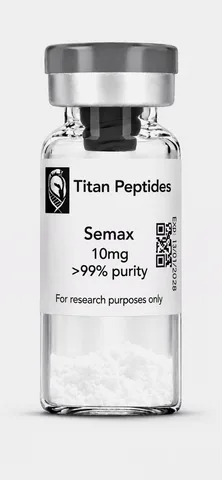
Semax research peptide, lyophilised vial

Semax

Lyophilised vial · supplied for laboratory research

10mg Semax 10mg
$79.99
AT A GLANCE
  • Supplied as a lyophilised powder in a sealed vial.
  • Dispatched within Australia, usually within 24 business hours of payment clearing.
  • For laboratory research use only. Not for human or veterinary use.
  • Handling & storage · Quick answers

About Semax

Semax is a synthetic heptapeptide, Met-Glu-His-Phe-Pro-Gly-Pro. The first four residues match positions 4 to 7 of adrenocorticotropic hormone (ACTH); the final three form a Pro-Gly-Pro "glyproline" tail that makes the molecule harder for peptidases to cut. Semax originated in Russia, and most published work on it comes from Russian Academy of Sciences institutes in Moscow.

Titan Peptides supplies Semax as a lyophilised powder in a sealed 10 mg vial for laboratory research only. This research-grade material is not the Russian registered product and is not an approved medicine in any country. Below: specifications, a referenced summary of the rodent and clinical studies, regulatory status and handling notes.

Specifications

Compound classSynthetic heptapeptide; ACTH(4-7) analogue with a C-terminal Pro-Gly-Pro
Sequence (one-letter)MEHFPGP
Sequence (three-letter)Met-Glu-His-Phe-Pro-Gly-Pro
Molecular formulaC37H51N9O10S (PubChem)
Molar mass813.9 g/mol (PubChem)
CAS number80714-61-0
PubChem CID9811102
Other namesACTH(4-7)PGP; described in papers as an ACTH(4-10) analogue
Supplied asLyophilised powder, sealed vial
Strength10 mg per vial
Storage (lyophilised)Sealed, dry and dark at −20 °C or colder; warm to room temperature in a desiccator before opening
Intended useLaboratory research only

What the research covers

Design. Despite its ACTH-derived start, Semax is reported to lack ACTH's hormonal action on the adrenal glands, and its developers added the Pro-Gly-Pro tail to make it more resistant to peptidases.1

BDNF signalling in rats. The best-known mechanistic work concerns brain-derived neurotrophic factor (BDNF). A 2006 rat experiment found that one application of Semax was followed by roughly 1.4-fold more BDNF protein in the hippocampus and about 1.6-fold more phosphorylation of the BDNF receptor trkB, and the treated rats made more conditioned avoidance responses in a learning task.2

Experimental stroke. Middle cerebral artery occlusion in rats is the model behind most Semax papers. Using RNA-Seq after temporary occlusion, a 2020 study counted 394 genes whose expression differed from saline controls at 24 hours; inflammation-related genes were down and neurotransmission-related genes up.3 These are tissue measurements from animals, not evidence of a mechanism, and they cannot be read across to people.

Human studies. Clinical data are sparse and mostly published in Russian. In a 2018 study of 110 stroke patients at early or late stages of rehabilitation, those given Semax had higher plasma BDNF and higher Barthel index recovery scores, according to the authors; the abstract mentions no randomisation, blinding or placebo.4 ClinicalTrials.gov listed no registered Semax trials when searched in September 2026.

A single Moscow research network produced much of this literature, and outside replication is limited. The Semax research overview reviews the evidence in full, and Semax vs Selank sets it against its sister peptide, Selank.

Read the full Semax research overview

Status in Australia

Russia includes Semax on its government list of vital and essential medicines.1 In the United States it is not an approved drug, and Drugs@FDA holds no product containing it.5 The FDA's compounding safety page records "semax (heptapeptide)" as a former category 2 substance whose nomination was withdrawn, flags a potential immunogenicity risk, and says the agency lacked sufficient information to know whether it would cause harm in humans.6

Semax does not appear by name in Australia's June 2026 Poisons Standard (F2026L00633).7 The way a product is supplied and presented also affects how it is regulated; see our guide to Australian research peptide law. The research-grade Semax sold here is not an approved medicine. Nor is Semax named in the 2026 WADA Prohibited List, but that is not the same as permitted: the List's catch-all wording can reach unnamed substances, a question for anti-doping authorities.8

Handling & storage

The methionine in Semax carries a sulphur-containing side chain that oxidises easily, so limit its exposure to oxygen, moisture and light. Keep the sealed vial dry, dark and at −20 °C or colder. Bring it to room temperature in a desiccator before opening, because a cold peptide powder draws water from the air, and close it again quickly; supplier guidance suggests displacing the air with nitrogen or argon for methionine-containing sequences. Peptides do not keep well in solution, so divide any stock into single-use aliquots and freeze them rather than refreezing. More on storing lyophilised and reconstituted peptides and choosing a diluent for reconstitution.

Semax quick answers

What form is Semax supplied in?

Semax comes as a lyophilised (freeze-dried) powder in a sealed 10 mg vial, sold for laboratory research only and intended for in vitro and animal-model work. It is not the medicine registered in Russia, and no regulator has assessed this research-grade material as a medicine.

What is the difference between Semax and Selank?

Both end in the same Pro-Gly-Pro tail, but the parent peptides are unrelated. Semax attaches the tail to ACTH(4-7), a hormone fragment; Selank attaches it to tuftsin, a fragment of immunoglobulin G. Semax papers centre on experimental stroke and BDNF signalling, Selank papers on rodent anxiety models and GABA-A binding. Only Semax contains methionine.

What is Semax's CAS number?

PubChem lists Semax under CAS number 80714-61-0 and CID 9811102. Its molecular formula is C37H51N9O10S and its molar mass 813.9 g/mol, and the one-letter sequence is MEHFPGP. Checking these identifiers against a vial and its documentation confirms you are working with the molecule described in the published studies.

Is Semax legal in Australia?

Semax is not named in the June 2026 Poisons Standard. A research label does not settle the question, because the Therapeutic Goods Act 1989 treats anything presented as, or likely to be taken as, being for therapeutic use as a therapeutic good. The Semax sold here is not an approved medicine and is for laboratory research only.

Is Semax approved as a medicine anywhere?

Only in Russia, which includes it on the government's list of vital and essential drugs. It has no FDA approval, and when the European Medicines Agency's medicines dataset was checked in September 2026 it contained no centrally authorised product with Semax. The research-grade material is not the Russian medicine.
From the research library

Compound Research

Semax: What the Research Says About This ACTH-Derived Peptide

Semax is a seven-amino-acid ACTH fragment analogue listed as an essential medicine in Russia but not approved in the US or EU. Here is what the rodent and small clinical studies report, and how much weight they can bear.

21 September 2026 · 8 min read
Comparisons

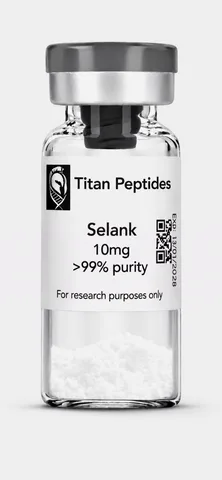
Semax vs Selank: How the Two Russian Peptides Compare

Semax and Selank share a Russian origin and the same Pro-Gly-Pro tail, but they are built on different parent peptides and studied in different models. Here is how they compare, study by study.

20 September 2026 · 8 min read
Lab Handling

How to Store Peptides: Lyophilised Powder and Solutions

A laboratory guide to storing lyophilised and reconstituted peptides: freezer temperatures, moisture, oxidation-prone residues, light, freeze–thaw cycles and adsorption to containers.

21 September 2026 · 7 min read

References

  1. Radchenko AI, et al. The Potential of the Peptide Drug Semax and Its Derivative for Correcting Pathological Impairments in the Animal Model of Alzheimer's Disease. Acta Naturae. 2025;17(4):110-120. PubMed 41479572
  2. Dolotov OV, et al. Semax, an analog of ACTH(4-10) with cognitive effects, regulates BDNF and trkB expression in the rat hippocampus. Brain Res. 2006;1117(1):54-60. PubMed 16996037
  3. Filippenkov IB, et al. Novel Insights into the Protective Properties of ACTH(4-7)PGP (Semax) Peptide at the Transcriptome Level Following Cerebral Ischaemia-Reperfusion in Rats. Genes (Basel). 2020;11(6):681. PubMed 32580520
  4. Gusev EI, et al. [The efficacy of semax in the treatment of patients at different stages of ischemic stroke]. Zh Nevrol Psikhiatr Im S S Korsakova. 2018;118(3 Vyp 2):61-68. Article in Russian. PubMed 29798983
  5. U.S. Food and Drug Administration. Drugs@FDA: FDA-Approved Drugs database. Searched for "semax" via the openFDA drugsfda endpoint, 21 September 2026: no matching products. Source
  6. U.S. Food and Drug Administration. Certain Bulk Drug Substances for Use in Compounding that May Present Significant Safety Risks. Content current as of 22 April 2026. Source
  7. Therapeutic Goods (Poisons Standard—June 2026) Instrument 2026 (SUSMP No. 48), F2026L00633, commenced 1 June 2026. Federal Register of Legislation. Source
  8. World Anti-Doping Agency. World Anti-Doping Code International Standard: Prohibited List 2026. In effect 1 January 2026. Source

Research Use Only

All products are supplied strictly for laboratory research and in-vitro applications. They are not approved therapeutic goods in Australia and are not for human or veterinary use.