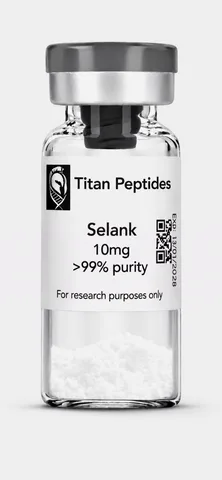
What form is Selank supplied in?
Selank comes as a lyophilised (freeze-dried) powder in a sealed 10 mg vial, sold for laboratory research only. Peptide powders usually include a counter-ion such as acetate and some residual water, so the mass of peptide itself is less than the weight of powder in the vial. The specifications above give free-peptide values from PubChem.
How does Selank differ from Semax?
Both are Russian heptapeptides ending in Pro-Gly-Pro, but their parent sequences are unrelated. Selank builds on tuftsin, an immunoglobulin G fragment; Semax builds on ACTH(4-7), a hormone fragment. Selank work centres on rodent anxiety models and GABA-A binding, Semax work on experimental stroke and BDNF. Direct comparisons between the two are rare.
What is Selank's CAS number?
PubChem lists Selank under CAS number 129954-34-3 and CID 11765600, with the synonym TP-7. For the free peptide it gives the molecular formula C33H57N11O9 and a molar mass of 751.9 g/mol; salt forms such as selank acetate weigh more per mole, so check which form a document refers to.
Is Selank legal in Australia?
Selank does not appear by name in the June 2026 Poisons Standard. The Therapeutic Goods Act 1989 defines therapeutic goods partly by presentation, so goods likely to be taken as being for therapeutic use are caught whatever their label says. The Selank sold here is not an approved medicine and is for laboratory research only.
Is Selank a benzodiazepine?
No. Selank is a seven-residue peptide with no benzodiazepine structure. A laboratory binding study suggests it modulates GABA-A receptors allosterically, at a site distinct from, though possibly overlapping, the diazepam site. The FDA has said it lacks important information about the safety of selank acetate in humans.