MOTS-c: The Mitochondrial-Derived Peptide and What Research Shows
MOTS-c is a 16-residue peptide encoded in mitochondrial DNA. Here is what the cell, mouse and human studies report, what is still unknown, and how WADA classifies it.
HOME / RESEARCH COMPOUNDS / MOTS-C
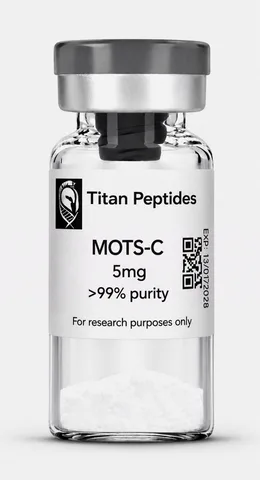
Lyophilised vial · supplied for laboratory research
MOTS-c is a 16-amino-acid signalling peptide coded by the mitochondrion's own genome, within its 12S rRNA gene, rather than by nuclear DNA. Reported in 2015, it belongs with humanin to the mitochondrial-derived peptides, and the name stands for mitochondrial open reading frame of the 12S rRNA-c.
Titan Peptides supplies MOTS-c as a lyophilised powder in a sealed 5 mg vial for laboratory research only. It is not an approved medicine and is not for human or veterinary use. Below: specifications, a referenced summary of the cell, mouse and human studies, regulatory status and handling notes.
| Compound class | Mitochondrial-derived peptide (16 residues) |
|---|---|
| Full name | Mitochondrial open reading frame of the 12S rRNA-c |
| Sequence (one-letter) | MRWQEMGYIFYPRKLR |
| Molecular formula | C101H152N28O22S2 (PubChem) |
| Molar mass | 2174.6 g/mol (PubChem) |
| CAS number | 1627580-64-6 |
| PubChem CID | 146675088 |
| Origin | Short open reading frame in the mitochondrial 12S rRNA gene; first reported 2015 |
| Supplied as | Lyophilised powder, sealed vial |
| Strength | 5 mg per vial |
| Storage (lyophilised) | Sealed, dry and dark at −20 °C or colder; warm to room temperature in a desiccator before opening |
| Intended use | Laboratory research only |
Metabolism in cells and mice. The team that identified MOTS-c in 2015 found skeletal muscle to be its apparent main target. Their cell experiments showed it blocking the folate pathway and the purine synthesis that depends on it, so that the intermediate AICAR builds up and switches on AMPK, a cellular energy sensor. In mice, they reported that it prevented the insulin resistance that develops with age or on a high-fat diet.1 A 2018 follow-up in cultured cells found that glucose restriction sent MOTS-c into the nucleus, by an AMPK-dependent route, where it acted on genes with antioxidant response elements and interacted with the transcription factor NRF2.2
Physical capacity and exercise. A 2021 paper reported higher physical performance in young, middle-aged and old mice treated with MOTS-c. It also sampled 10 sedentary young men during ergometer exercise: their own muscle MOTS-c was 11.9-fold higher after exercise, and circulating levels rose about 1.6-fold during it.3 That describes the endogenous peptide, not the effect of giving it.
A gene variant. An mtDNA variant seen in North-East Asian populations turns residue 14 from lysine into glutamine (K14Q). Pooling three cohorts (27,527 people), a meta-analysis tied the variant to more type 2 diabetes among male carriers, with no such association in women. In high-fat-fed male mice, the K14Q peptide did not reproduce the glucose-tolerance change seen with the standard sequence.4
Clinical trials. No controlled trial giving MOTS-c to people has yet published clinical outcomes. A registered phase 2a study, NCT07505745, is comparing it with placebo in adults with prediabetes; recruitment opened in February 2026 and no results are posted.5 Many foundational papers share authors, some declaring commercial interests, so independent replication is thin.2,3 The MOTS-c research overview covers each study, and peptides and the WADA Prohibited List explains its anti-doping classification.
Australia's June 2026 Poisons Standard (F2026L00633) does not name MOTS-c.6 No MOTS-c medicine is approved, and the research-grade material sold here is not one. How a product is supplied and presented also shapes its legal position; our guide to Australian research peptide law sets out the framework.
For sport, MOTS-c appears by name in section S4.4.1 of the 2026 WADA Prohibited List, in the group of AMP-activated protein kinase activators that also includes AICAR. The category is non-Specified and banned at all times, in and out of competition.7 Sport Integrity Australia, the national anti-doping organisation, names MOTS-C among the unapproved peptides it flags as prohibited in sport, and defines unapproved peptide products as goods not entered on the Australian Register of Therapeutic Goods.8
With two methionines and a tryptophan in its sequence, MOTS-c is prone to oxidation, so air, moisture and light all count. Store the vial sealed, dark, dry and frozen; supplier guidance runs from −20 °C for short periods to −80 °C for long-term storage. Warm it to room temperature inside a desiccator before opening so no condensation forms on the powder, then reseal promptly; for methionine- or tryptophan-containing sequences, flushing the headspace with nitrogen or argon is recommended. Solutions keep poorly: split a stock into single-use aliquots, freeze them and do not refreeze a thawed tube. More on storing lyophilised and reconstituted peptides and choosing a diluent for reconstitution.
Titan Peptides supplies MOTS-c as a lyophilised (freeze-dried) powder in a sealed 5 mg vial, for laboratory research only. It is intended for in vitro and animal-model work, is not an approved medicine and is not supplied for human or veterinary use.
PubChem lists MOTS-c under CAS number 1627580-64-6 and CID 146675088, with the sequence MRWQEMGYIFYPRKLR, the molecular formula C101H152N28O22S2 and a molar mass of 2174.6 g/mol. These identifiers let you match a vial, its documentation and the published literature to the same molecule.
MOTS-c does not appear by name in the June 2026 Poisons Standard, and no medicine containing it is approved. A research label does not settle status: the Therapeutic Goods Act 1989 covers goods presented as, or likely to be taken as, being for therapeutic use. MOTS-c from Titan Peptides is sold for laboratory research only.
Yes. It is one of the named AMPK activators in section S4.4.1, metabolic modulators, of the 2026 WADA Prohibited List. That category is non-Specified and banned both in and out of competition. Sport Integrity Australia also flags MOTS-C as an unapproved peptide that is prohibited in sport.
Not in published form. Human work so far has measured the body's own MOTS-c, for example during exercise, or studied the K14Q gene variant. NCT07505745, a phase 2a placebo-controlled study in adults with prediabetes and overweight or obesity, opened recruitment in February 2026 with an estimated 120 participants and has no posted results.
MOTS-c is a 16-residue peptide encoded in mitochondrial DNA. Here is what the cell, mouse and human studies report, what is still unknown, and how WADA classifies it.
A laboratory guide to storing lyophilised and reconstituted peptides: freezer temperatures, moisture, oxidation-prone residues, light, freeze–thaw cycles and adsorption to containers.
Which peptides does the 2026 WADA Prohibited List name, in which section, and what does "not named" really mean? Includes GLP-1 drugs, retatrutide and Sport Integrity Australia.
All products are supplied strictly for laboratory research and in-vitro applications. They are not approved therapeutic goods in Australia and are not for human or veterinary use.