Check identity first: the sequence, formula and mass on a COA must belong to the compound named, and a COA for a different peptide is a red flag whatever its purity figure.
HPLC purity is the main peak's share of UV-absorbing peak area; it is not the share of the powder that is peptide.
Net peptide content accounts for counter-ions and water, and Bachem notes it is not equivalent to purity.
Trifluoroacetate counter-ions left from purification have altered results in cell-culture experiments, so the salt form matters for bench work.
A credible COA shows the chromatogram, the mass spectrum, the methods, the lot number, the laboratory and a dated signature.
A peptide certificate of analysis (COA) is the testing laboratory's record of what was measured on one specific batch: usually identity by mass spectrometry and purity by HPLC, and sometimes net peptide content, counter-ion, water and endotoxin. Read it in this order: does the identity match the compound named, what does the purity figure actually measure, how much of the powder is peptide, and who did the testing?
A COA is only as useful as your ability to check it. This guide walks through each section, what it can and cannot tell you, and the red flags that should make you stop and ask questions.
What a peptide certificate of analysis should contain
The peptide manufacturer Bachem frames quality control around four questions: is it the desired product, how pure is it, what by-products does it contain, and how high is the product content?1 A useful certificate answers them with data for the specific batch:
Section
What it tells you
What to check
Compound, sequence, formula, theoretical mass
What the batch is supposed to be
Matches the product you ordered, residue by residue
Lot number and dates
Which batch was tested, and when
The lot matches your vial; the test date is plausible
Identity by mass spectrometry
The observed molecular mass
Agrees with the theoretical mass for that sequence
Purity by HPLC
Main-peak area as a percentage of all peaks
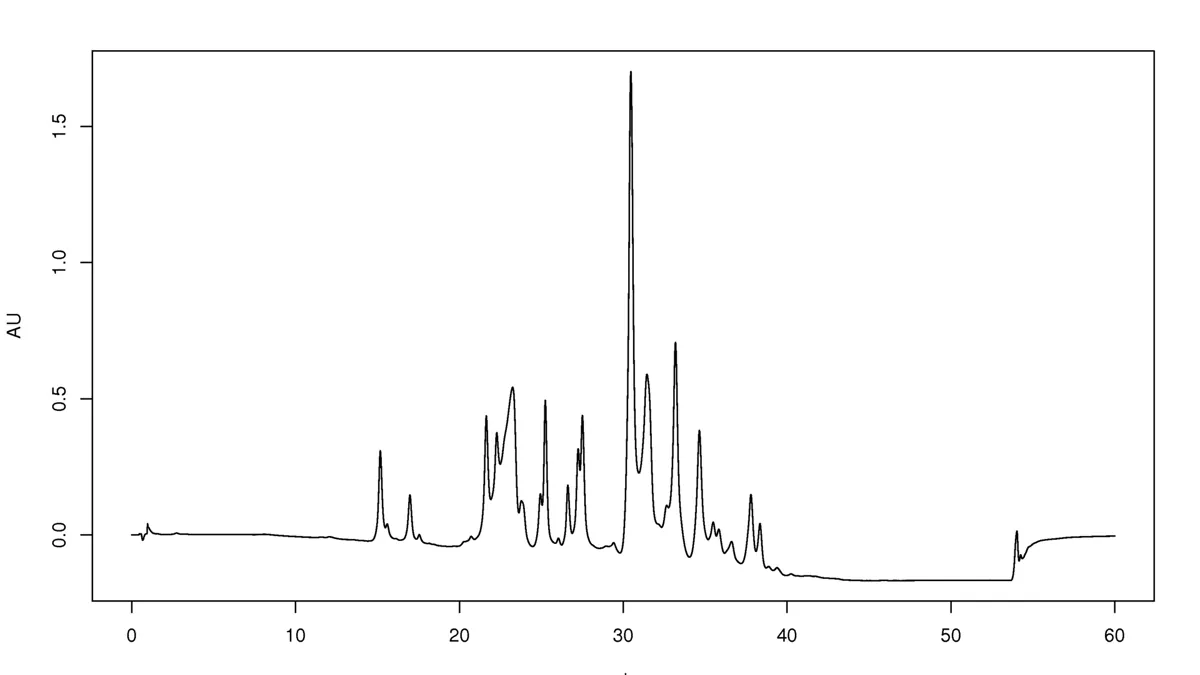
Method, wavelength and chromatogram are shown
Net peptide content
How much of the powder is peptide
Method stated, for example nitrogen analysis or amino acid analysis
Counter-ion
Salt form, such as trifluoroacetate or acetate
Relevant if you run cell-based assays
Water and residual solvents
Non-peptide mass
Karl Fischer titration; gas chromatography
Endotoxin (if stated)
Bacterial endotoxin level, often in EU/mg
The method is named and a number is given
Laboratory details
Who tested it
Laboratory name, approver, signature and date
Identity: does the COA match the compound named?
This is the first check and the easiest to fail. The sequence, molecular formula and mass on the certificate must belong to the compound on the vial. A certificate that shows a different sequence, a different formula or a mass belonging to another peptide is a red flag whatever its purity figure says, because high purity of the wrong molecule is worthless.
You can check the theoretical values yourself on PubChem. For example:
Two details trip people up. First, the average molar mass (used for weighing) and the monoisotopic mass (the lightest isotopic form, which high-resolution instruments report) are different numbers; for BPC-157 on PubChem the gap is about 0.8. Second, electrospray mass spectrometry produces a series of multiply charged ions6, so a spectrum may show its main peaks at m/z values well below the molecular mass. For BPC-157, the doubly protonated ion ([M+2H]2+) would appear near m/z 710.4. The certificate should either report the deconvoluted mass or say which charge state it is quoting. Our guide to HPLC and mass spectrometry explains these readouts in more detail.
An observed mass that differs from the expected value by the mass of one amino acid residue, one oxygen atom or a protecting group points to a specific synthesis or degradation impurity, such as a deletion sequence, an oxidised residue or incomplete deprotection, rather than the target peptide.7
Purity: what the HPLC percentage does and does not tell you
For peptides, analytical HPLC with UV detection at 210–220 nm is the standard purity method, and "the area of the main peak in relation to the total area of all peaks reflects the peptide purity".1 A figure such as 98.6% therefore means that 98.6% of the UV-absorbing peak area, under those conditions, belongs to the main peak. It does not mean:
That 98.6% of the powder is peptide. Water and counter-ions are not measured by the purity method.1
That every impurity is counted equally. At 214 nm, tryptophan absorbs about 30 times more strongly than a peptide bond, and phenylalanine, tyrosine and histidine about six times more, so impurities of different composition give different signals per mole.8
That nothing is hiding under the main peak. An impurity that co-elutes with the target inflates the figure; mass spectrometry across the peak helps catch it.
That no unrelated peptide is present. In one vaccine-research case, an HIV peptide from a commercial supplier contained about 1% by weight of a cytomegalovirus peptide, enough to produce false-positive T-cell responses.9
Ask for the chromatogram, not just the number. A certificate that states a purity but shows no trace, method, column or wavelength gives you nothing to check.
Higher is not automatically necessary, but it has to fit the use. Bachem's own grade guide recommends more than 95% purity for NMR and crystallography and for peptides used as references in quantitative enzyme–substrate, receptor–ligand and competition studies; 90–95% for quantitative assays, monoclonal antibody production and in vitro or in vivo studies; and more than 80% for qualitative work such as western blotting.1 It also notes that purity varies from batch to batch and that peptidic by-products in lower-purity batches can have biological activity of their own.1
Peptide content vs purity
Bachem defines net peptide content (NPC) as "the percentage of peptides relative to non-peptidic material (mostly counterions and moisture)", and stresses that "NPC and purity are not equivalent, because the former includes peptidic contaminants". It adds that basic peptides can have a low NPC even when extremely pure, because of salt formation, and that hydrophilic peptides can absorb considerable moisture.1 NPC is often estimated from nitrogen content by elemental analysis. Amino acid analysis, which breaks the peptide down with strong acid and quantifies the released amino acids, confirms composition but gives no sequence information.1
A 2024 test-purchase study shows why the distinction matters. Researchers made test purchases from illegal online pharmacies and analysed the three lyophilised semaglutide vials that were delivered, using liquid chromatography–mass spectrometry. Each chromatogram showed a single semaglutide signal with no peptide-like impurities, yet semaglutide made up only 7.7% to 14.4% of the powder's total weight, against the 99% purity claimed by the sellers. The semaglutide content per vial exceeded the labelled amount by 28.6% to 38.7%, and endotoxin was detected in all samples.10 A purity claim, a content figure and a label amount are three different numbers.
Counter-ions, water and residual solvents
Peptides purified by reverse-phase HPLC are often isolated as trifluoroacetate (TFA) salts, because trifluoroacetic acid is part of the mobile phase.11 Bachem notes that TFA "cannot be completely removed due to salt formation" and suggests ordering a different salt form where residual TFA is a concern.1 It can be a concern. In cell culture, TFA at 10 to 100 nM reduced proliferation of osteoblasts and chondrocytes, and the TFA salts of amylin and calcitonin consistently gave less proliferation than the hydrochloride salts, enough to hide a proliferative effect or suggest an antiproliferative one that was not there.11 A review of counter-ions in peptides describes how the salt form also affects structure and physicochemical properties.12
Bachem lists the methods behind the rest of the non-peptide mass: water by Karl Fischer titration, residual solvents by gas chromatography, acetate by HPLC or ion chromatography, and residual TFA by ion chromatography.1 Together with NPC, these results explain the gap between a purity figure and the amount of peptide you can actually weigh out. Moisture also changes after the vial is opened, which is one reason storage matters; see how to store peptides.
Endotoxin and sterility claims
An endotoxin result should name its method. The FDA's guidance on pyrogen and endotoxins testing (revised March 2026) describes the gel-clot, photometric and kinetic methods set out in USP chapter <85>, the Bacterial Endotoxins Test.13 Results are usually reported per milligram of material, for example in EU/mg. Sterility is a separate test: in the semaglutide study above, sterility and endotoxin were assessed under different pharmacopoeial chapters, and the samples were free of viable microorganisms yet still contained endotoxin.10 A certificate that reports one does not establish the other. For sterile handling at the bench, see reconstituting peptides aseptically.
Peptide COA example: reading one line by line
Here is how the checks come together on a hypothetical certificate for 10 mg of angiotensin II, a peptide widely used as a laboratory standard. The certificate and its figures are invented for illustration; the reference values are PubChem's.14
COA line (hypothetical)
Check
Verdict
Sequence DRVYIHPF; formula C50H71N13O12
Matches the PubChem record for angiotensin II
The identity claim names the right molecule
ESI-MS, monoisotopic mass 1045.5
Matches PubChem's monoisotopic mass of 1045.53
Consistent
HPLC purity 98.2% at 220 nm, chromatogram attached
Wavelength and trace provided
Checkable
Net peptide content 78% (nitrogen analysis); counter-ion trifluoroacetate
About 7.8 mg of the 10 mg is peptide
Adjust stock concentrations accordingly
Lot number, test date, laboratory, signature
Lot matches the vial label
Traceable
Change a single line and the verdict changes. A mass that does not match 1045.5, a sequence belonging to another peptide or a lot number that does not match the vial would each make the rest of the certificate irrelevant. For converting net peptide content into an accurate stock concentration, see the arithmetic in our guide to reconstituting peptides.
Who tested it?
The laboratory's name and address, not just a logo.
A named analyst or approver, a signature and a date.
The methods used, with enough detail (column, wavelength, instrument type) to judge them.
Whether the laboratory is accredited to ISO/IEC 17025, the international standard for testing laboratories, and whether that particular test falls within its accredited scope.
A way to verify the report with the laboratory, if one is offered.
Red flags on a peptide COA
The sequence, formula or mass belongs to a different peptide from the one named.
No lot number, or a lot number that does not match the vial.
A purity figure with no chromatogram, method or wavelength.
An identity claim with no mass spectrum or observed mass.
Identical results, dates or chromatograms across different lots or different compounds.
No laboratory name, signatory or date.
Purity quoted as if it were content, with no net peptide content anywhere.
A peptide certificate of analysis (COA) is a laboratory report for one specific batch. It normally states the compound and sequence, the lot number, identity by mass spectrometry and purity by HPLC, and may add net peptide content, counter-ion, water, residual solvents and endotoxin. It should name the testing laboratory, the methods and the date, and include the underlying chromatogram and spectrum.
What purity should a research peptide have?
It depends on the experiment. Bachem's grade guide suggests above 95% for NMR, crystallography and reference use in quantitative studies such as receptor–ligand or enzyme–substrate work, 90–95% for many quantitative assays and in vitro or in vivo studies, and above 80% for qualitative work such as western blotting. Whatever the grade, identity has to be confirmed first.
What is net peptide content on a COA?
Net peptide content is the percentage of the powder that is peptide rather than non-peptide material, mostly counter-ions such as trifluoroacetate and water. It is not the same as purity: purity comes from HPLC peak areas, while content is usually estimated from nitrogen analysis or amino acid analysis. Basic and hydrophilic peptides can have low net peptide content even when very pure.
Does 99% purity mean the vial is 99% peptide?
No. HPLC purity is the main peak's share of UV-absorbing peak area, so water and counter-ions are not part of the figure. In a 2024 study of lyophilised semaglutide bought online, each sample showed a single semaglutide peak, yet semaglutide was only 7.7% to 14.4% of the powder's weight, against the 99% purity claimed by the sellers.
How can you tell if a peptide COA does not check out?
Check that the sequence, formula and mass match the compound named, that the lot number matches your vial, and that a chromatogram, mass spectrum, methods, laboratory name, signatory and date are all present. Identical data across different lots or compounds is a warning sign. If the laboratory offers a way to verify reports, use it, and confirm its accreditation covers that test.
References
Bachem. Quality control of amino acids and peptides: a guide (Peptide Guide, chapter 7). Accessed September 2026. Source
PubChem. BPC-157 (H-GEPPPGKPADDAGLV-OH), CID 9941957. National Center for Biotechnology Information. Source
PubChem. Selank (Thr-Lys-Pro-Arg-Pro-Gly-Pro), CID 11765600. National Center for Biotechnology Information. Source
PubChem. Semax (Met-Glu-His-Phe-Pro-Gly-Pro), CID 9811102. National Center for Biotechnology Information. Source
PubChem. Delta sleep-inducing peptide (H-WAGGDASGE-OH), CID 68816. National Center for Biotechnology Information. Source
Fenn JB, Mann M, Meng CK, Wong SF, Whitehouse CM. Electrospray ionization for mass spectrometry of large biomolecules. Science. 1989;246(4926):64-71. PubMed 2675315
D'Hondt M, Bracke N, Taevernier L, et al. Related impurities in peptide medicines. J Pharm Biomed Anal. 2014;101:2-30. PubMed 25044089
Kuipers BJ, Gruppen H. Prediction of molar extinction coefficients of proteins and peptides using UV absorption of the constituent amino acids at 214 nm to enable quantitative reverse phase high-performance liquid chromatography-mass spectrometry analysis. J Agric Food Chem. 2007;55(14):5445-51. PubMed 17539659
Currier JR, Galley LM, Wenschuh H, et al. Peptide impurities in commercial synthetic peptides and their implications for vaccine trial assessment. Clin Vaccine Immunol. 2008;15(2):267-76. PubMed 18077621
Ashraf AR, Mackey TK, Vida RG, et al. Multifactor quality and safety analysis of semaglutide products sold by online sellers without a prescription: market surveillance, content analysis, and product purchase evaluation study. J Med Internet Res. 2024;26:e65440. PubMed 39509151
Cornish J, Callon KE, Lin CQ, et al. Trifluoroacetate, a contaminant in purified proteins, inhibits proliferation of osteoblasts and chondrocytes. Am J Physiol. 1999;277(5):E779-83. PubMed 10567002
Sikora K, Jaśkiewicz M, Neubauer D, Migoń D, Kamysz W. The role of counter-ions in peptides—an overview. Pharmaceuticals (Basel). 2020;13(12):442. PubMed 33287352
US Food and Drug Administration. Pyrogen and endotoxins testing: questions and answers. Guidance for industry, revised March 2026. Source
PubChem. Angiotensin II (Asp-Arg-Val-Tyr-Ile-His-Pro-Phe), CID 172198. National Center for Biotechnology Information. Source
Research use only. This article summarises published scientific literature
for educational purposes. It is not medical advice and does not describe or endorse human
or veterinary use. Compounds supplied by Titan Peptides are for laboratory research only
and are not approved therapeutic goods in Australia.
How reverse-phase HPLC and mass spectrometry are used to test peptide purity and identity, how to read a chromatogram and a mass spectrum, and what each method cannot tell you.
What bacteriostatic water actually contains, how it compares with sterile water, when benzyl alcohol can interfere, and how to reconstitute a lyophilised peptide and calculate stock concentrations.
A laboratory guide to storing lyophilised and reconstituted peptides: freezer temperatures, moisture, oxidation-prone residues, light, freeze–thaw cycles and adsorption to containers.