Free Express Shipping on Orders Over $150 Research Use Only
Free Express Shipping Over $150
PREMIUM HPLC-VERIFIED BATCHES NOW AVAILABLE • USE CODE WELCOME15 FOR 15% OFF YOUR FIRST ORDER

HOME  /  RESEARCH COMPOUNDS  /  DSIP

DSIP RESEARCH PEPTIDE

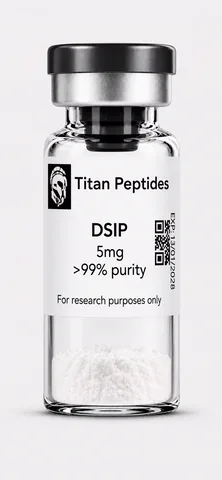
DSIP research peptide, lyophilised vial

DSIP

Lyophilised vial · supplied for laboratory research

10mg DSIP 10mg
$69.99
AT A GLANCE
  • Supplied as a lyophilised powder in a sealed vial.
  • Dispatched within Australia, usually within 24 business hours of payment clearing.
  • For laboratory research use only. Not for human or veterinary use.
  • Handling & storage · Quick answers

About DSIP

DSIP, or delta sleep-inducing peptide, is a linear nonapeptide, Trp-Ala-Gly-Gly-Asp-Ala-Ser-Gly-Glu, with the international non-proprietary name emideltide. A Swiss group isolated it in 1977 from rabbits in which electrical brain stimulation had induced sleep, and named it after the slow delta-wave EEG pattern it seemed to increase. What it does in the body, if anything, remains unresolved.

Titan Peptides supplies DSIP as a lyophilised powder in a sealed 10 mg vial for laboratory research only. It is not an approved medicine. Below: specifications, a referenced summary of the animal and human studies, regulatory status and handling notes.

Specifications

Compound classLinear nonapeptide
Sequence (one-letter)WAGGDASGE
Sequence (three-letter)Trp-Ala-Gly-Gly-Asp-Ala-Ser-Gly-Glu
Molecular formulaC35H48N10O15 (PubChem)
Molar mass848.8 g/mol (PubChem)
CAS number62568-57-4 (PubChem also lists 69431-45-4)
PubChem CID68816
Other namesEmideltide (INN); delta sleep-inducing peptide
OriginIsolated from rabbit cerebral venous blood plasma, Basel, 1977
Supplied asLyophilised powder, sealed vial
Strength10 mg per vial
Storage (lyophilised)Sealed, dry and dark at −20 °C or colder; warm to room temperature in a desiccator before opening
Intended useLaboratory research only

What the research covers

Discovery. Schoenenberger and Monnier worked from the cerebral venous blood of rabbits whose thalamus had been stimulated electrically. After sequencing the peptide they synthesised it alongside candidate fragments and related peptides and tested each by infusion into rabbit brain ventricles in a double-blind design; they reported that synthetic DSIP alone produced a significant, specific rise in delta and spindle EEG activity.1

An unresolved origin. Nobody has isolated a gene, a confirmed precursor protein or a receptor for DSIP. A 2006 review titled it "a still unresolved riddle", judged the sleep-factor hypothesis "extremely poorly documented and still weak", and recalled that the reviewers' own early experiments saw slow-wave sleep effects with some synthetic analogues but not with DSIP itself.2

Stability. A 1987 study found DSIP broken down quickly when incubated in human or rat blood, whereas two analogues lasted longer.3 Any experiment that delivers the peptide systemically has to contend with that.

Human studies. The human data are few and inconsistent. In 1992 an independent Amsterdam group ran a double-blind study in 16 chronic insomniacs and saw only weak shifts in sleep efficiency and latency, possibly reflecting a change in the placebo group; they judged short-term DSIP unlikely to be of major value in that condition.4 A 2009 randomised study in 24 women under general anaesthesia recorded the reverse of what was expected: less delta activity and lighter anaesthesia on the bispectral index.5 ClinicalTrials.gov showed no registered DSIP or emideltide trials in September 2026.

Most of the literature is old, with over three-quarters of PubMed records on the peptide published before 2000. Our DSIP research article covers the full record, and what research peptides are explains how such compounds are made and labelled.

Read the full DSIP research overview

Status in Australia

DSIP has no FDA approval; Drugs@FDA holds no product containing emideltide or DSIP.6 Australia's June 2026 Poisons Standard (F2026L00633) names neither DSIP nor emideltide.7 Whether a product counts as a therapeutic good depends on its supply and presentation; see our guide to Australian research peptide law. The research-grade DSIP sold here is not an approved medicine.

DSIP is also absent by name from the 2026 WADA Prohibited List. Absence is not permission: the List's examples are "including, but not limited to", and its S0 and S2 wording can capture substances it does not name. Anti-doping authorities decide whether that applies to a particular compound.8

Handling & storage

DSIP starts with a tryptophan, a residue vulnerable to oxidation and to photo-oxidation, and the 1987 blood data show how fast enzymes can degrade it, so handling conditions matter. Keep the sealed vial dry, dark and at −20 °C or colder, bring it to room temperature in a desiccator before opening, and close it quickly, ideally under nitrogen or argon. Make solutions under clean conditions, divide them into single-use aliquots and freeze them, avoiding repeated freeze–thaw. Since a DSIP antiserum once recognised an unrelated brain peptide, confirm identity by mass spectrometry rather than immunoassay. More on storing lyophilised and reconstituted peptides and choosing a diluent for reconstitution.

DSIP quick answers

What form is DSIP supplied in?

DSIP comes as a lyophilised (freeze-dried) powder in a sealed 10 mg vial, sold for laboratory research only and intended for in vitro and animal-model work. It is not an approved medicine, and Drugs@FDA lists no product containing DSIP or emideltide.

What is emideltide?

Emideltide is DSIP's international non-proprietary name (INN), the name regulators use. On the FDA's compounding safety page, current to April 2026, Emideltide (DSIP) appears as a former category 2 substance whose nomination was withdrawn; the FDA cited a potential immunogenicity risk and said it had not identified safety information for the proposed route.

What is DSIP's CAS number?

PubChem gives DSIP the CAS number 62568-57-4 and also lists 69431-45-4. Its PubChem CID is 68816, its molecular formula C35H48N10O15 and its molar mass 848.8 g/mol. The one-letter sequence is WAGGDASGE. Because two CAS numbers circulate, search databases and supplier documents under both.

Is DSIP legal in Australia?

Neither DSIP nor emideltide is named in the June 2026 Poisons Standard. Labelling alone does not decide status: the Therapeutic Goods Act 1989 covers goods presented as, or likely to be taken as, being for therapeutic use. The DSIP sold here is not an approved medicine and is for laboratory research only.

How is DSIP different from melatonin?

Structurally they are unrelated. Melatonin is a small indoleamine that the pineal gland makes from tryptophan; DSIP is a nine-amino-acid peptide for which no site of synthesis, gene or receptor has been confirmed. The two are often mentioned together but are not interchangeable in a study design.
From the research library

Compound Research

DSIP Peptide (Delta Sleep-Inducing Peptide): What the Research Shows

Delta sleep-inducing peptide was discovered in 1977 and named for the brain waves it seemed to promote in rabbits. Nearly fifty years on, its origin in the body is unresolved and the human evidence is small and inconsistent.

20 September 2026 · 7 min read

References

  1. Schoenenberger GA, Monnier M. Characterization of a delta-electroencephalogram (-sleep)-inducing peptide. Proc Natl Acad Sci U S A. 1977;74(3):1282-1286. PubMed 265572
  2. Kovalzon VM, Strekalova TV. Delta sleep-inducing peptide (DSIP): a still unresolved riddle. J Neurochem. 2006;97(2):303-309. PubMed 16539679
  3. Graf MV, Saegesser B, Schoenenberger GA. Degradation and aggregation of delta sleep-inducing peptide (DSIP) and two analogs in plasma and serum. Peptides. 1987;8(4):599-603. PubMed 3628078
  4. Bes F, et al. Effects of delta sleep-inducing peptide on sleep of chronic insomniac patients. A double-blind study. Neuropsychobiology. 1992;26(4):193-197. PubMed 1299794
  5. Pomfrett CJ, et al. Delta sleep-inducing peptide alters bispectral index, the electroencephalogram and heart rate variability when used as an adjunct to isoflurane anaesthesia. Eur J Anaesthesiol. 2009;26(2):128-134. PubMed 19142086
  6. U.S. Food and Drug Administration. Drugs@FDA: FDA-Approved Drugs database. Searched for "emideltide", "DSIP" and "delta sleep" via the openFDA drugsfda endpoint, 21 September 2026: no matching products. Source
  7. Therapeutic Goods (Poisons Standard—June 2026) Instrument 2026 (SUSMP No. 48), F2026L00633, commenced 1 June 2026. Federal Register of Legislation. Source
  8. World Anti-Doping Agency. World Anti-Doping Code International Standard: Prohibited List 2026. In effect 1 January 2026. Source

Research Use Only

All products are supplied strictly for laboratory research and in-vitro applications. They are not approved therapeutic goods in Australia and are not for human or veterinary use.