TB-500 and Thymosin Beta-4: What the Research Shows
TB-500 and thymosin beta-4 are not the same molecule. This overview explains the fragment, the full-length protein most studies used, the thin human data, and the Australian and WADA position.
HOME / RESEARCH COMPOUNDS / TB-500
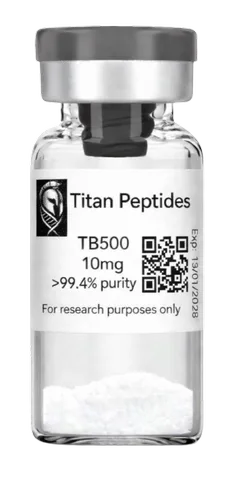
Lyophilised vial · supplied for laboratory research
TB-500 is a synthetic heptapeptide, Ac-LKKTETQ: a copy of residues 17–23 of thymosin beta-4 (Tβ4) with an acetyl group added to the N-terminus. Doping-control laboratories identified this fragment as the active ingredient of products sold under the TB-500 name. It is far smaller than its 43-residue parent protein, about 889 against 4,963 g/mol, and the two should not be confused.
Titan Peptides supplies TB-500 as a lyophilised powder in a sealed 10 mg vial for laboratory research only; it is not a medicine and not for human or veterinary use. The summary below separates what has been reported for the fragment from what was reported for full-length Tβ4, and sets out its Australian and anti-doping status.
| Compound class | Synthetic N-acetylated heptapeptide; fragment of thymosin beta-4 (residues 17–23) |
|---|---|
| Sequence (one-letter) | Ac-LKKTETQ |
| Sequence (three-letter) | Ac-Leu-Lys-Lys-Thr-Glu-Thr-Gln-OH |
| Molecular formula | C38H68N10O14 (PubChem) |
| Molar mass | 889.0 g/mol (PubChem) |
| CAS number | 885340-08-9 |
| PubChem CID | 62707662 |
| Parent peptide | Thymosin beta-4, 43 residues, 4963 g/mol (PubChem CID 16132341, CAS 77591-33-4) |
| Other names | TB 500 |
| Supplied as | Lyophilised powder, sealed vial |
| Strength | 10 mg per vial |
| Storage (lyophilised) | Sealed, dry and dark at −20 °C or colder; −50 to −80 °C for long-term storage |
| Intended use | Laboratory research only |
Analytical chemistry pinned down what TB-500 is. The Hong Kong Jockey Club's racing laboratory described it as a preparation whose key ingredient is LKKTETQ "with artificial acetylation of the N-terminus", and published a liquid chromatography–mass spectrometry method that detected the peptide and its metabolites in horse urine and plasma.1 Beyond that, the evidence divides sharply by molecule:
The practical consequence is that the large Tβ4 literature cannot simply be read across to TB-500. Our TB-500 and thymosin beta-4 research overview covers both bodies of work, and BPC-157 vs TB-500 compared explains how it differs from BPC-157.
In the Poisons Standard June 2026 (F2026L00633), TB-500 and thymosin beta 4 each have their own Schedule 4 entry, and both are listed in Appendix D, clause 5: poisons that must not be possessed without authority, such as a legal prescription.6 The TGA's 13 April 2026 safety advisory names TB-500 among its examples of unapproved peptide products and states that a "research use only" disclaimer does not make supply lawful.7 The 2026 WADA Prohibited List names "thymosin-β4 and its derivatives e.g. TB-500" in class S2.3, growth factors and growth factor modulators, prohibited at all times.8
TB-500 is not an approved medicine, and the vial sold here is a research chemical. See are research peptides legal in Australia? and peptides and the WADA Prohibited List.
Store the sealed vial dry, dark and frozen at −20 °C or colder (−50 to −80 °C for long-term storage), and let it warm to room temperature in a desiccator before opening. The C-terminal glutamine is one of the residues the storage literature flags as prone to deamidation, which is a reason not to keep TB-500 in solution for long: split a reconstituted stock into single-use aliquots, freeze them, and do not refreeze a thawed aliquot. See how to store peptides and reconstituting peptides with bacteriostatic or sterile water for the reasoning behind each step.
PubChem records TB-500 as Ac-Leu-Lys-Lys-Thr-Glu-Thr-Gln-OH (Ac-LKKTETQ), CID 62707662 and CAS 885340-08-9, with formula C38H68N10O14 and molar mass 889.0 g/mol. The sequence matches residues 17 to 23 of mature thymosin beta-4, with an acetyl group on the leucine that the natural protein does not carry at that position.
Thymosin beta-4 is a naturally occurring 43-residue peptide of about 4,963 g/mol with several mapped active regions. TB-500 is a seven-residue synthetic fragment of about 889 g/mol carrying only the central actin-binding region. Mass spectrometry separates them easily, and research on the full protein should not be attributed to the fragment.
TB-500 is supplied as a lyophilised powder in a sealed vial containing 10 mg, for laboratory research only. Because 'TB-500' is a product name rather than an official nonproprietary name, a sample's documented sequence and an observed mass matching Ac-LKKTETQ define what it contains. A missing N-terminal acetyl group would lower the mass by 42 Da.
TB-500 is listed in Schedule 4 of the June 2026 Poisons Standard and in Appendix D, clause 5, so it must not be possessed without authority, such as a legal prescription; thymosin beta 4 is listed the same way. The TGA names TB-500 as an unapproved peptide product and says a research-use-only label does not make supply lawful.
TB-500 and thymosin beta-4 are not the same molecule. This overview explains the fragment, the full-length protein most studies used, the thin human data, and the Australian and WADA position.
A plain-English review of the BPC-157 literature: where the peptide came from, what animal and cell studies reported, why human evidence is so thin, and where it sits under Australian scheduling and anti-doping rules.
Two peptides that are often mentioned together but have nothing structurally in common. A side-by-side look at where BPC-157 and TB-500 come from, what studies reported, and where each sits under Australian and WADA rules.
Which peptides does the 2026 WADA Prohibited List name, in which section, and what does "not named" really mean? Includes GLP-1 drugs, retatrutide and Sport Integrity Australia.
All products are supplied strictly for laboratory research and in-vitro applications. They are not approved therapeutic goods in Australia and are not for human or veterinary use.