HOME / RESEARCH COMPOUNDS / BACTERIOSTATIC WATER
BACTERIOSTATIC WATER LABORATORY DILUENT
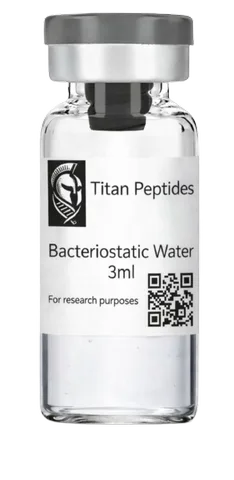
Bacteriostatic Water
3 mL vial · laboratory diluent for reconstituting lyophilised peptides
- Supplied in a sealed 3 mL vial.
- Dispatched within Australia, usually within 24 business hours of payment clearing.
- For laboratory research use only. Not for human or veterinary use.
- Handling & storage · Quick answers
About Bacteriostatic Water
Bacteriostatic water is water with benzyl alcohol added as a preservative, so that a multi-use vial can be entered more than once without bacterial growth taking hold. Laboratories use it as a diluent for reconstituting lyophilised peptides, though it is not the right choice for every peptide or assay.
Titan Peptides supplies bacteriostatic water in a 3 mL vial for laboratory use as a diluent for research peptides. Check the vial label for the exact benzyl alcohol concentration. Below: what published labels say, how it compares with sterile water, benzyl alcohol cautions and multi-use vial handling.
Specifications
| Contents | Bacteriostatic water |
|---|---|
| Volume | 3 mL |
| Preservative | Benzyl alcohol (check the vial label for concentration) |
| Intended use | Laboratory use: diluent for reconstituting lyophilised research peptides |
What the research covers
What the reference labels say. Hospira's US prescribing information for its bacteriostatic water, published on the National Library of Medicine's DailyMed, describes a sterile, nonpyrogenic preparation with benzyl alcohol at 0.9% (9 mg/mL) or 1.1% (11 mg/mL) as the bacteriostatic preservative, packed in a multi-use container that allows repeated withdrawals.1 The preservative holds back bacterial growth; it cannot make an already-contaminated solution sterile, which is why the label still requires aseptic technique for every entry.1
Compared with sterile water. Hospira's sterile water label describes a product with no bacteriostat, antimicrobial agent or added buffer, packed in single-use containers, with whatever is left after opening to be discarded.2 If a peptide is dissolved once, aliquoted and frozen immediately, the vial is never re-entered and the preservative offers nothing extra. Safe repeat entry into the same vial is the whole point of adding it.
Benzyl alcohol is not inert. The bacteriostatic water label warns that benzyl alcohol "has been associated with toxicity in neonates", and 1982 reports tied it to the neonatal "gasping syndrome".1,3 The label adds that some solutes may be incompatible with it.1 In formulation work on a recombinant protein, dissolving the freeze-dried product in 0.9% benzyl alcohol gave more aggregation than dissolving it in water.4 In cultured cells, benzyl alcohol fluidises membranes and caused a reversible break-up of the Golgi apparatus.5 These findings involve a protein and cell systems rather than short peptides, but they are why compatibility is tested, not assumed: run a vehicle control with the same benzyl alcohol concentration in cell-based work, or switch to sterile water or buffer if the assay is sensitive.
Choosing a diluent starts with the peptide's charge and hydrophobicity; our guide to bacteriostatic water and reconstituting peptides covers that in detail, and how to read a peptide COA explains where solubility information may be stated.
Status in Australia
The labels cited on this page are US prescribing information for two Hospira products, published on DailyMed.1,2 They describe those products, not the vial sold here. Titan Peptides supplies its 3 mL bacteriostatic water as a laboratory reagent, a diluent for reconstituting lyophilised research peptides. This page does not state the vial's benzyl alcohol concentration: read it from the vial label rather than assuming the 0.9% common on US labels, and check its expiry date. The Hospira label also advises against keeping reconstituted solutions unless the manufacturer of the dissolved product says otherwise.1 The research-grade peptides it is used with are not approved medicines; see our guide to Australian research peptide law.
Handling & storage
Before each entry into an opened multi-use vial, wipe the septum with 70% alcohol and let it dry, and work with sterile single-use consumables in a biological safety cabinet or laminar-flow bench. Look at the liquid first: the US label says not to use it unless the solution is clear and the seal intact. Note the date the vial was first opened, and store it as its own label directs. The preservative slows growth but cannot reverse contamination introduced at entry. A peptide solution made with it follows the peptide's storage guidance, not the diluent's, so aliquot and freeze it. More on storing lyophilised and reconstituted peptides and choosing a diluent for reconstitution.
Bacteriostatic Water quick answers
What concentration of benzyl alcohol does this vial contain?
Check the label on the vial you receive; this page does not state it. For comparison, the US Hospira labels on DailyMed list bacteriostatic water at 0.9% (9 mg/mL) or 1.1% (11 mg/mL) benzyl alcohol. The figure matters if the solution will go into a cell-based assay, where a matched vehicle control is advisable.
Is bacteriostatic water the same as sterile water?
No. The bacteriostatic version adds benzyl alcohol so that the vial can be re-entered. Sterile water, as Hospira labels it, has no bacteriostat, antimicrobial agent or added buffer; it is single-use, and whatever remains after opening should be thrown away. Which suits an experiment depends on the peptide and on how the solution will be used.
When is sterile water the better choice for peptide work?
When benzyl alcohol could interfere. In published work it raised aggregation of a reconstituted recombinant protein and disturbed membranes and Golgi trafficking in cultured cells. If a stock will be made once, aliquoted and frozen straight away, the preservative adds nothing, and sterile water or a sterile buffer avoids the interference.
Does benzyl alcohol sterilise the solution?
No. It slows bacterial growth but cannot sterilise a solution once contamination is in it. That is why the US label still calls for aseptic technique on every entry and withdrawal, and why clean technique at the bench matters more than the preservative.
Which peptides is bacteriostatic water used with?
It is a general laboratory diluent for lyophilised research peptides, not tied to any one compound. The best diluent depends on the sequence: basic peptides such as Selank, acidic peptides and hydrophobic peptides each have different starting solvents. Our reconstitution guide explains how to choose.
Related research compounds
References
- Hospira, Inc. Bacteriostatic Water for Injection, USP (0.9% and 1.1% benzyl alcohol), prescribing information, revised 08/2019. DailyMed, US National Library of Medicine. Source
- Hospira, Inc. Sterile Water for Injection, USP, prescribing information, revised 03/2026. DailyMed, US National Library of Medicine. Source
- Centers for Disease Control (CDC). Neonatal deaths associated with use of benzyl alcohol—United States. MMWR Morb Mortal Wkly Rep. 1982;31(22):290-1. PubMed 6810084
- Roy S, Jung R, Kerwin BA, Randolph TW, Carpenter JF. Effects of benzyl alcohol on aggregation of recombinant human interleukin-1-receptor antagonist in reconstituted lyophilized formulations. J Pharm Sci. 2005;94(2):382-96. PubMed 15614819
- Simm R, Kvalvaag AS, van Deurs B, Lindbäck T, Sandvig K. Benzyl alcohol induces a reversible fragmentation of the Golgi apparatus and inhibits membrane trafficking between endosomes and the trans-Golgi network. Exp Cell Res. 2017;357(1):67-78. PubMed 28450044
Research Use Only
All products are supplied strictly for laboratory research and in-vitro applications. They are not approved therapeutic goods in Australia and are not for human or veterinary use.