Retatrutide: The Triple Agonist and What the Research Shows
Retatrutide (LY3437943) is Eli Lilly's investigational GIP, GLP-1 and glucagon triple agonist. Here is what the phase 1 to phase 3 research reports, and where it stands in September 2026.
HOME / RESEARCH COMPOUNDS / RETATRUTIDE
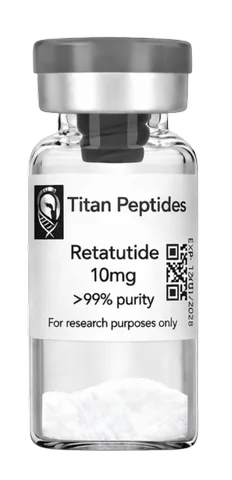
Lyophilised vial · supplied for laboratory research
Retatrutide (development code LY3437943) is a synthetic, fatty-acid-modified peptide designed by Eli Lilly to activate three hormone receptors at once: GIP, GLP-1 and glucagon, hence the term "triple agonist". It is an investigational drug in Lilly's phase 3 program and is not approved as a medicine in any country.
Titan Peptides supplies research-grade retatrutide as a lyophilised powder in sealed 10 mg and 20 mg vials for laboratory research only. It is not Lilly's clinical-trial material and is not for human or veterinary use. Below is a summary of the published research and of the compound's regulatory position.
| Compound class | Synthetic fatty-acid-modified peptide; GIP, GLP-1 and glucagon receptor agonist (triple agonist) |
|---|---|
| Development code | LY3437943 |
| Structure | Contains non-coded residues (α-aminoisobutyric acid at position 2, α-methyl-L-leucine at position 13) and a fatty diacid linked to lysine 17; cannot be written fully in one-letter code |
| Molecular formula | C221H342N46O68 (PubChem) |
| Molar mass | 4731 g/mol (PubChem computed value) |
| CAS number | 2381089-83-2 (PubChem depositor records) |
| PubChem CID | 171390338 |
| Developer | Eli Lilly and Company (investigational; not approved) |
| Supplied as | Lyophilised powder, sealed vial |
| Strength | 10 mg or 20 mg per vial |
| Storage (lyophilised) | Sealed, dry and dark at −20 °C or colder; −50 to −80 °C for long-term storage |
| Intended use | Laboratory research only |
Lilly's 2022 discovery paper reported that, in cell assays, LY3437943 had roughly balanced activity at the glucagon and GLP-1 receptors and greater activity at the GIP receptor. In obese mice, the authors attributed its effect on body weight partly to reduced food intake and partly to energy expenditure mediated by the glucagon receptor; how much that mechanism contributes in people is still being studied.1 Cryo-electron microscopy structures published in 2024 showed the peptide bound to each of the three receptors as a single continuous helix.2
How retatrutide compares with single and dual incretin agonists is covered in retatrutide vs tirzepatide vs semaglutide, and the full trial table is in our retatrutide research overview.
Retatrutide is not named in the Poisons Standard June 2026 (F2026L00633).6 The TGA's 13 April 2026 safety advisory nonetheless names retatrutide as an example of an unapproved peptide product, one that has not been evaluated by the TGA for safety, quality or effectiveness, and states that a "research use only" disclaimer does not make supply lawful.7 Lilly describes retatrutide as investigational and says it cannot legally be sold or marketed for human use.4 It is not named in the 2026 WADA Prohibited List, but class S0 covers pharmacological substances without government approval for human therapeutic use and gives drugs under clinical development as examples.8
See are research peptides legal in Australia? and peptides and the WADA Prohibited List.
Store sealed vials dry, dark and frozen at −20 °C or colder, moving to −50 to −80 °C for long-term storage, and let each vial reach room temperature in a desiccator before opening. Keep solutions short-lived: divide a reconstituted stock into single-use aliquots, freeze them and avoid freeze–thaw cycles. Container choice matters at low concentrations, too: a study of endocrine peptides, GLP-1 among them, found that recovery differed between tube surfaces, so check recovery rather than assume it. See how to store peptides and reconstituting peptides with bacteriostatic or sterile water for the reasoning behind each step.
Research-grade retatrutide is supplied as a lyophilised powder in sealed vials of either 10 mg or 20 mg, for laboratory research only. Both contain the same compound; the figure is the quantity per vial. Neither is Lilly's investigational medicine or clinical-trial material, and neither is for human or veterinary use.
PubChem depositor records give retatrutide the CAS number 2381089-83-2, and PubChem (CID 171390338) lists the formula C221H342N46O68 with a computed molar mass of 4731 g/mol. Its sequence cannot be written fully in one-letter code because it contains α-aminoisobutyric acid, α-methyl-L-leucine and a fatty diacid attached at lysine 17.
Retatrutide is not approved by the TGA or any other regulator. It is not named in the June 2026 Poisons Standard, but the TGA lists it as an example of an unapproved peptide product and says a research-use-only label does not make supply lawful. ClinicalTrials.gov lists Australian sites for several of Lilly's phase 3 trials.
Semaglutide activates the GLP-1 receptor and tirzepatide the GIP and GLP-1 receptors; both are approved medicines. Retatrutide adds glucagon-receptor activity and remains investigational. No head-to-head results have been reported: TRIUMPH-5, comparing retatrutide with tirzepatide, has an estimated primary completion of November 2026, and cross-trial comparisons of headline figures are unreliable.
LY3437943 is Eli Lilly's development code for retatrutide. It appears in the titles of the 2022 discovery paper and the phase 1b trial report and in ClinicalTrials.gov records, so searching PubMed or the trial registry under both names captures the full literature on the compound.
Retatrutide (LY3437943) is Eli Lilly's investigational GIP, GLP-1 and glucagon triple agonist. Here is what the phase 1 to phase 3 research reports, and where it stands in September 2026.
Semaglutide targets one receptor, tirzepatide two and retatrutide three. We compare their pharmacology and published trials, and explain why cross-trial numbers mislead.
All products are supplied strictly for laboratory research and in-vitro applications. They are not approved therapeutic goods in Australia and are not for human or veterinary use.