GHK-Cu Copper Peptide: What the Research Shows
GHK-Cu is the best-known copper peptide. This overview covers its chemistry, the collagen and wound-model research, the thin and partly negative human evidence, and the names that get confused with it.
HOME / RESEARCH COMPOUNDS / GHK-CU
Lyophilised vial · supplied for laboratory research
GHK-Cu is the copper(II) complex of GHK (glycyl-L-histidyl-L-lysine), a tripeptide first reported in human plasma in 1973 that binds copper strongly. It is the best-known "copper peptide": cosmetic ingredient lists call it copper tripeptide-1, and its nonproprietary drug name is prezatide copper.
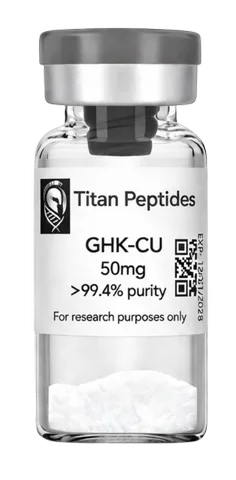
Titan Peptides supplies GHK-Cu as a lyophilised powder in a sealed 50 mg vial for laboratory research only. It is not a medicine and is not for human or veterinary use. The summary below covers what cell, animal and human studies have reported, how the complex behaves at the bench, and its regulatory status.
| Compound class | Copper(II)–tripeptide complex |
|---|---|
| Sequence (one-letter) | GHK (Gly-His-Lys), complexed with Cu(II) |
| Molecular formula | C14H23CuN6O4+ (1:1 complex as recorded by PubChem, prezatide copper); C14H24N6O4 (free GHK) |
| Molar mass | 402.92 g/mol (1:1 complex as recorded, PubChem); 340.38 g/mol (free GHK) |
| CAS number | 89030-95-5 (prezatide copper); 49557-75-7 (GHK) |
| PubChem CID | 71587328 (prezatide copper); 73587 (GHK) |
| Other names | Copper tripeptide-1, prezatide copper, GHK copper |
| Supplied as | Lyophilised powder, sealed vial |
| Strength | 50 mg per vial |
| Storage (lyophilised) | Sealed, dry and dark at −20 °C or colder; −50 to −80 °C for long-term storage |
| Intended use | Laboratory research only |
Most GHK-Cu data come from cell culture and animal wound models, and the controlled human evidence is thin.
Much of the review literature is written by GHK's discoverer and co-authors, and positive facial-skin findings cited in a 2015 review trace to a pilot study, a meeting presentation, a university report and a book chapter rather than to randomised trials in indexed peer-reviewed journals.5 Our GHK-Cu copper peptide research overview covers the evidence in depth, and what research peptides are explains the research-use-only framework.
GHK-Cu is not named in the Poisons Standard June 2026 (F2026L00633). The instrument does contain a general Schedule 4 entry for "copper compounds for human use", with exceptions that include preparations containing 5% or less of copper compounds.6 The TGA's 13 April 2026 safety advisory names GHK-Cu as an example of an unapproved peptide product, not evaluated by the TGA for safety, quality or effectiveness, and states that a "research use only" disclaimer does not make supply lawful.7 GHK-Cu does not appear by name in the 2026 WADA Prohibited List, which is not the same as being permitted.8
The GHK-Cu sold here is a research chemical, not an approved medicine. See are research peptides legal in Australia?
Store the sealed vial dry, dark and frozen at −20 °C or colder, and let it reach room temperature in a desiccator before opening. The copper centre adds two bench considerations: the complex exists as several species depending on pH, so buffer choice can change what is actually in solution, and its blue colour can interfere with absorbance-based or colorimetric assays. PubChem holds records for both 1:1 and 2:1 peptide-to-copper forms, so confirm which form a document describes before comparing its formula or mass with a record. Keep solutions short-lived, in single-use frozen aliquots. See how to store peptides and reconstituting peptides with bacteriostatic or sterile water for the reasoning behind each step.
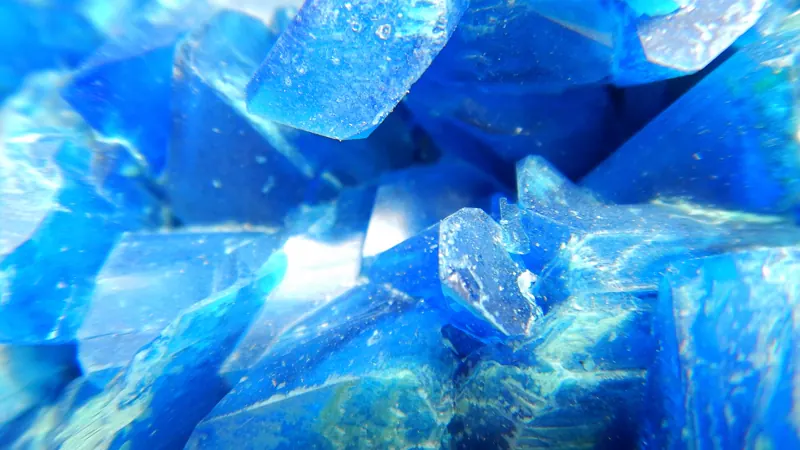
GHK-Cu is supplied as a lyophilised powder in a sealed vial containing 50 mg, for laboratory research only. Solutions of the complex are blue, the usual colour of copper(II) compounds of this type. Because PubChem records 1:1 and 2:1 peptide-to-copper forms with different formulas and masses, the stated form and any counter-ion matter when reading documentation.
PubChem lists prezatide copper, the 1:1 copper complex also called copper tripeptide-1, under CAS 89030-95-5 and CID 71587328, with formula C14H23CuN6O4+ and molar mass 402.92 g/mol as recorded. Free GHK, the tripeptide without copper, has CAS 49557-75-7 and CID 73587, formula C14H24N6O4 and molar mass 340.38 g/mol.
No. AHK-Cu is L-alanyl-L-histidyl-L-lysine bound to copper, a different complex. A frequently cited hair-follicle study used AHK-Cu, not GHK-Cu, and reported follicle elongation ex vivo and more proliferation of cultured dermal papilla cells. Results for one copper peptide should not be attributed to another, so check the sequence a study used rather than the label 'copper peptide'.
GHK-Cu is not named in the June 2026 Poisons Standard, which does contain a general Schedule 4 entry for copper compounds for human use. The TGA lists GHK-Cu among its examples of unapproved peptide products and says a research-use-only label does not make supply lawful. The GHK-Cu sold here is a research chemical, not an approved medicine.
GHK-Cu is the best-known copper peptide. This overview covers its chemistry, the collagen and wound-model research, the thin and partly negative human evidence, and the names that get confused with it.
All products are supplied strictly for laboratory research and in-vitro applications. They are not approved therapeutic goods in Australia and are not for human or veterinary use.