CATALOGUE / GLOW BLEND
GLOW BLEND 10 + 50 + 10MG
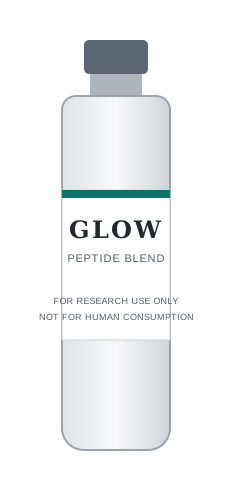
GLOW Blend
Research peptide · Lyophilised powder in a sealed vial · for laboratory and research use only
Reagent specifications
| CAS number | None: a mixture has no single CAS number. Components: BPC-157 137525-51-0; GHK-Cu 89030-95-5; TB-500 885340-08-9 |
|---|---|
| Molecular weight | Per component: BPC-157 1419.5 g/mol; GHK-Cu 402.92 g/mol (1:1 copper complex); TB-500 889.0 g/mol (PubChem reference values) |
| Storage | Sealed, dry and dark at −20 °C or colder; −50 to −80 °C for long-term storage |
| Certificate of analysis | Not published: a certificate that matches this blend has not been supplied · Request a COA |
Component formulas, molecular weights and CAS numbers are PubChem reference values. Quantities are as labelled by the supplier and have not been independently verified.
Compound identity
| Compound class | Lyophilised blend of three synthetic research peptides |
|---|---|
| Composition as labelled by the supplier | BPC-157 10 mg + GHK-Cu 50 mg + TB-500 10 mg per vial |
| BPC-157 | GEPPPGKPADDAGLV; C62H98N16O22; PubChem CID 9941957 |
| GHK-Cu | Gly-His-Lys copper(II) complex; C14H23CuN6O4+; PubChem CID 71587328 |
| TB-500 | Ac-LKKTETQ; C38H68N10O14; PubChem CID 62707662 |
| Other names | GLOW, Glow peptide, GLOW blend |
| Supplied as | Lyophilised powder, sealed vial |
| Purity | Not published |
| Intended use | Laboratory and research use only |
About GLOW Blend
GLOW is a trade name for a lyophilised blend of three research peptides in one vial: BPC-157, GHK-Cu and TB-500. The supplier labels the vial as BPC-157 10 mg, GHK-Cu 50 mg and TB-500 10 mg. It is a physical mixture, not a new compound, so it has no CAS number or PubChem record of its own: each component keeps its own identity, listed below.1
Titan Peptides supplies the blend as a lyophilised powder in a sealed vial, for laboratory and research use only. It is a research chemical: not a drug, food or cosmetic, and not for human consumption.
Status in Australia
In the Therapeutic Goods (Poisons Standard—June 2026) Instrument 2026, which commenced on 1 June 2026, BPC-157 is listed in Schedule 4 (prescription-only medicines) and in Appendix D, clause 5, the table of poisons that "must not be possessed by a person without authority". TB-500 and thymosin beta 4 each have their own entry in Schedule 4 and are also listed in Appendix D, clause 5.2 The TGA's 13 April 2026 safety advisory names BPC-157, TB-500 and GHK-Cu as examples of unapproved peptide products and states that a "research use only" disclaimer does not make supply lawful.3
A blend containing them is not an approved therapeutic good in Australia; the vial sold here is a research chemical. Our guide to research peptides and Australian law explains how scheduling applies.
Laboratory handling & storage
Keep the sealed vial dry, dark and frozen at −20 °C or colder, and let it reach room temperature in a desiccator before opening. A blend is only as stable as its least stable component: TB-500's C-terminal glutamine can deamidate in solution, and the copper complex changes species with pH. Because three peptides share one solution, choose a solvent compatible with all of them, free of chelators such as EDTA that would strip copper from GHK-Cu. Keep any reconstituted stock as frozen single-use aliquots and do not refreeze a thawed aliquot. See how to store peptides and reconstituting peptides.
GLOW Blend quick answers
What is in the GLOW peptide blend?
GLOW is a trade name for a lyophilised mixture of three research peptides in one vial: BPC-157, GHK-Cu and TB-500. The supplier labels the vial as BPC-157 10 mg, GHK-Cu 50 mg and TB-500 10 mg. Each component keeps its own CAS number and PubChem record.
Does GLOW have a CAS number?
No. A CAS number identifies a single substance, and GLOW is a mixture. The components are BPC-157 (CAS 137525-51-0), GHK-Cu (CAS 89030-95-5) and TB-500 (CAS 885340-08-9).
How should the GLOW blend be stored?
Sealed, dry and dark at −20 °C or colder. Warm the vial to room temperature in a desiccator before opening, and keep any reconstituted solution as frozen single-use aliquots.
Is a certificate of analysis published for this blend?
Not yet. A purity figure is shown only when a certificate that matches the product is on file; none has been supplied for this blend.
Related catalogue items
References
- PubChem. BPC-157, CID 9941957; Prezatide copper, CID 71587328; TB-500 (Ac-LKKTETQ), CID 62707662. National Center for Biotechnology Information. Source
- Therapeutic Goods (Poisons Standard—June 2026) Instrument 2026 (Standard for the Uniform Scheduling of Medicines and Poisons No. 48), F2026L00633. Commenced 1 June 2026. Federal Register of Legislation. Source
- Therapeutic Goods Administration. Understanding your responsibilities when importing, compounding and supplying unapproved peptide products (safety advisory). Published 13 April 2026. Source