What form is BPC-157 supplied in?
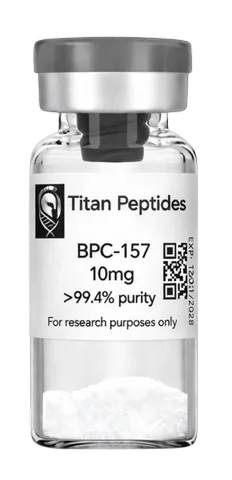
BPC-157 is supplied as a lyophilised (freeze-dried) powder in a sealed vial containing 10 mg, for laboratory research only. Peptides are often supplied as salts, and PubChem also records a trifluoroacetate form of BPC-157, so documentation for a salt form can list a different formula and mass from the free-peptide values of C62H98N16O22 and 1419.5 g/mol.
What is BPC-157's CAS number?
The CAS number for BPC-157 is 137525-51-0, and its PubChem compound ID is 9941957. The same peptide appears in the literature as PL 14736, PLD-116, PL-10 and bepecin; a 2003 paper noted that it was then in clinical trials for inflammatory bowel disease under the Pliva codes PL 14736 and PLD-116.
What is BPC-157's legal status in Australia?
BPC-157 is a Schedule 4 substance in the June 2026 Poisons Standard and is also listed in Appendix D, clause 5, which covers poisons that must not be possessed without authority, such as a legal prescription. The TGA names it as an unapproved peptide product and says a research-use-only label does not make supply lawful. States and territories implement scheduling through their own legislation.
How is BPC-157 different from TB-500?
They are unrelated molecules. BPC-157 is a 15-residue fragment of a gastric juice protein; TB-500 is a synthetic, N-acetylated seven-residue fragment of thymosin beta-4 (Ac-LKKTETQ). Their proposed mechanisms in laboratory models differ, their molar masses differ by about 530 g/mol, and no study has compared the two head to head.
Has BPC-157 been through clinical trials?
No randomised controlled trial of BPC-157 has been published. The human data are three small pilot reports of two to 16 people, none with a control group. A phase I study of an oral tablet, registered in 2015, lists its status as unknown and has posted no results. A 2025 systematic review found no clinical safety data.