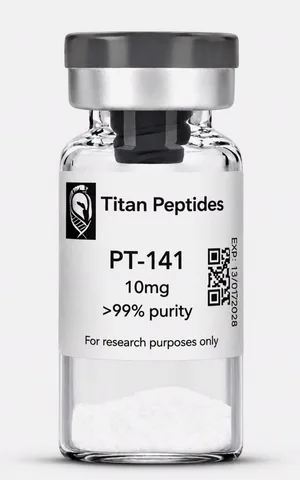
Is PT-141 the same product as Vyleesi?
No. PT-141 and bremelanotide name the same cyclic heptapeptide, but Vyleesi is a specific FDA-approved finished product: a sterile solution with defined excipients, made and labelled under an approved US application. A lyophilised PT-141 powder sold for laboratory research is none of those things and carries none of that approval.
What is PT-141's CAS number?
The CAS number for bremelanotide free base is 189691-06-3, and the acetate salt has its own number, 1607799-13-2. PubChem (CID 9941379) lists the free base as C50H68N14O10 with a molar mass of 1025.2 g/mol, matching the FDA label, so the salt form matters when comparing a formula or mass against a record.
Is PT-141 a form of melanotan II?
No, although the two are closely related. They share the same cyclic seven-residue sequence, but melanotan II ends in a C-terminal amide and bremelanotide in a free carboxylic acid, a mass difference of about 1 g/mol. Low-resolution mass measurements can miss that gap, so identity work calls for high-resolution mass spectrometry or chromatography against a reference standard.
Is PT-141 legal in Australia?
Bremelanotide is not named in the June 2026 Poisons Standard. Its US approval as Vyleesi covers that specific product and does not by itself make bremelanotide an approved medicine in Australia. Research-grade PT-141 is supplied for laboratory research only; our guide to research peptides and Australian law sets out how the TGA treats unapproved peptide products.