A peptide is a short chain of amino acids joined by peptide bonds; US regulations treat chains of more than 40 amino acids as proteins.
Most research peptides are made by solid-phase peptide synthesis, the method Bruce Merrifield introduced in 1963 and won the 1984 Nobel Prize in Chemistry for.
Synthesis leaves characteristic impurities, such as deletion sequences and trifluoroacetate counter-ions, which is why purity and identity testing matter.
Peptides are lyophilised (freeze-dried) because removing water slows many degradation reactions, though freezing and drying carry their own stresses.
"Research use only" describes intended use; it is not a quality grade and does not change a substance's legal status or make it a medicine.
Research peptides are short chains of amino acids, usually made by chemical synthesis and supplied as a freeze-dried powder, that are sold for laboratory research rather than as medicines. The "research use only" (RUO) label means the material is intended for in vitro or animal research, has not been evaluated or approved as a medicine, and is not for human or veterinary use, even when the same molecule exists elsewhere as an approved drug.
This primer covers the basics behind every compound in our research library: what a peptide is, where the line between peptides and proteins falls, how peptides are made, why they are freeze-dried, and what the RUO label does and does not mean. It ends with a map of the library.
What are peptides? Amino acids and the peptide bond
Peptides are built from amino acids. Each amino acid has an amino group, a carboxyl group and a distinctive side chain, and twenty of them are encoded in the genetic code. When the carboxyl group of one amino acid reacts with the amino group of the next, the two join through a peptide (amide) bond and a molecule of water is released. Repeat that and you get a chain with a free amino group at one end, the N-terminus, and a free carboxyl group at the other, the C-terminus.
Sequences are written from N-terminus to C-terminus, usually in one-letter code. Semax, for example, is MEHFPGP: methionine, glutamic acid, histidine, phenylalanine, proline, glycine, proline (see our Semax research overview). DSIP is WAGGDASGE. Two residues make a dipeptide, three a tripeptide, and a few to a few dozen an oligopeptide or peptide.
The body uses peptides extensively as hormones and signalling molecules, and they have a long history as medicines: since insulin was introduced almost a century ago, more than 80 peptide drugs have reached the market.1
Peptides vs proteins: where is the line?
There is no sharp biological boundary. Textbooks often put it at around 50 amino acids, and the practical distinction is that proteins usually fold into stable three-dimensional structures that small peptides do not.
Regulators have had to draw a line. US federal regulations define a protein as any alpha amino acid polymer with a specific, defined sequence that is greater than 40 amino acids in size; where two or more chains are associated as they occur in nature, their amino acids are counted together.2 Under that definition a chain of 40 or fewer amino acids is a peptide, while a two-chain hormone of 51 residues such as insulin counts as a protein. Most research peptides are far shorter: Semax and Selank have seven residues, DSIP nine.
How are research peptides made?
Short peptides like those in this library are usually made by chemical synthesis rather than extracted from animals or expressed in cells. The dominant method is solid-phase peptide synthesis (SPPS), introduced by Bruce Merrifield in 1963.3 His idea was to anchor the growing chain to an insoluble resin bead so that excess reagents could simply be washed away after each step, which made synthesis faster and open to automation. Merrifield received the 1984 Nobel Prize in Chemistry "for his development of methodology for chemical synthesis on a solid matrix".4
Solid-phase peptide synthesis, step by step
Anchor. The C-terminal amino acid is attached to a resin bead. Chemical synthesis builds the chain from the C-terminus towards the N-terminus, the opposite direction to protein synthesis in cells.
Deprotect. A temporary protecting group on the anchored amino acid's amino group is removed.
Couple. The next amino acid, with its own amino group and reactive side chain protected, is chemically activated and joined to the chain.
Wash. Excess reagents and by-products are washed away, leaving the growing peptide on the bead.
Repeat deprotection, coupling and washing for every residue in the sequence.
Cleave. A strong acid releases the finished peptide from the resin and removes the side-chain protecting groups.
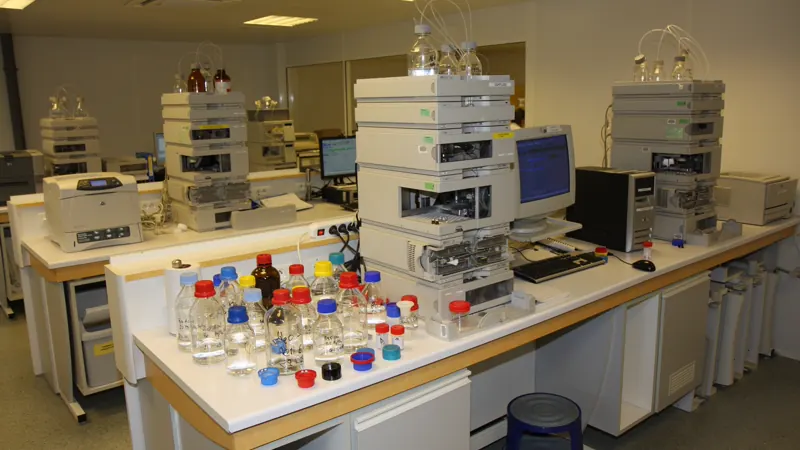
Purify and confirm. The crude product is purified, usually by reverse-phase HPLC, and its identity is confirmed by mass spectrometry, before the pure fractions are freeze-dried.
Today the usual chemistry uses the Fmoc protecting group, and Fmoc SPPS has become the method of choice for peptide synthesis; multi-tonne production of therapeutic peptides by the same method has made high-quality building blocks cheap and widely available.5
Each cycle is very efficient but never perfect, and small failures accumulate over a long sequence. A review of impurities in peptide medicines groups the synthesis-related ones as follows.6
Impurity
What it is
Typical origin
Deletion sequences
The target peptide missing one amino acid
Inefficient Fmoc removal, so a coupling step is skipped
Insertion sequences
The target peptide with an extra amino acid
Excess amino acid reagent
Diastereomers
A residue with the wrong handedness (racemisation)
Side reactions during deprotection
Protection adducts
Side-chain protecting groups left attached
Incomplete deprotection
Oxidation products, dimers and oligomers
Modified or linked copies of the peptide
Side-chain oxidation; peptide molecules joining together
A vial of peptide powder is never 100% peptide. Charged side chains and termini carry counter-ions, such as trifluoroacetate left over from synthesis and purification or acetate introduced by exchanging it, and the powder holds some residual water.6 The fraction of the powder that is actually peptide is called the net peptide content, and it is lower than the gross weight. Purity, by contrast, describes what share of the peptide material is the intended sequence rather than related impurities. The two numbers answer different questions, and molar calculations in the lab should account for both.
What is lyophilisation, and why are peptides freeze-dried?
Lyophilisation, or freeze-drying, removes water from a frozen product without melting it. The solution is frozen; in primary drying, the pressure is lowered so the ice sublimes directly to vapour; in secondary drying, the temperature is raised to drive off water still bound to the solid. What is left is a dry, porous cake or powder.
The reason is stability. In solution, peptides and proteins are exposed to water-driven degradation, and lyophilisation is the most commonly used method for preparing solid protein pharmaceuticals. It is not stress-free: freezing and drying can themselves damage proteins, and even dried products have limited long-term stability.7 Peptide-specific degradation routes include beta-elimination and the formation of diketopiperazines, pyroglutamate and succinimide.6
The phrase comes from US medical-device regulation. In vitro diagnostic products that are still in the laboratory research phase must carry the statement "For Research Use Only. Not for use in diagnostic procedures."8 Similar wording is now widely used on laboratory reagents and research chemicals.
On a peptide, an RUO label communicates that the material:
is intended for laboratory research, such as cell culture, biochemical assays and animal models;
has not been manufactured, tested or approved as a medicine;
is not for human or veterinary use, which is why no dosing information is supplied.
What the label does not do is change a substance's legal status. Under Australia's Therapeutic Goods Act 1989, therapeutic goods are goods that are represented in any way to be, or are likely to be taken to be, for therapeutic use.9 How a product is presented and promoted therefore matters, not just the words on the vial. Scheduling applies regardless of labelling too: the June 2026 Poisons Standard names several peptides that are also sold as research compounds in Schedule 4 (prescription only medicines), and lists some of them in Appendix D, clause 5, among poisons that must not be possessed without authority.10 Our article on whether research peptides are legal in Australia explains the framework.
Nor is RUO a quality grade. It says nothing about purity, identity or content; those are documented, if at all, in a certificate of analysis.
Research peptides vs approved peptide medicines
Approved peptide medicine
Research peptide (RUO)
Intended use
Use in patients, within approved indications
Laboratory research: in vitro and animal studies
Regulatory assessment
Evaluated by a regulator such as the TGA or FDA for quality, safety and efficacy
Not evaluated as a medicine
Evidence behind it
Clinical trials in humans
None required for sale as a research material
Labelling
Product information with indications and dosing for prescribers
Research use only; not for human or veterinary use; no dosing
The same molecule can sit on both sides of this table. A research-grade version of a compound that is also an approved drug is not that approved medicine: it has not been made or assessed to the medicine's standard, and it carries none of its approvals.
The research library: where to go next
Every article in our library applies the principles above to a specific compound or lab task, with the model, sample size and study type stated for each finding.
Titan Peptides supplies its peptide catalogue for laboratory research only.
Frequently asked questions
What are research peptides used for?
They are used in laboratory research: cell culture experiments, biochemical and binding assays, animal models and as analytical reference materials. Research peptides are not medicines. They carry a research-use-only label, have not been evaluated by a regulator for human use, and are not supplied for human or veterinary use.
What does research use only mean on peptides?
It means the material is intended for laboratory research, has not been manufactured, tested or approved as a medicine, and is not for human or veterinary use. The wording comes from US regulations for in vitro diagnostics in the research phase. It is not a quality grade and does not change a substance's legal status.
Are research peptides legal in Australia?
It depends on the substance and how it is presented. Goods represented as, or likely to be taken to be, for therapeutic use are therapeutic goods under the Therapeutic Goods Act 1989, whatever the label says, and some peptides are named in Schedule 4 of the Poisons Standard. Our Australian legal guide covers the detail.
Are research peptides the same as prescription peptide medicines?
No. A prescription peptide medicine has been evaluated by a regulator for quality, safety and efficacy and comes with approved indications and dosing. A research peptide has not been assessed as a medicine, even when it is the same molecule as an approved drug, and it is supplied for laboratory research only.
Why are research peptides sold as a powder?
They are lyophilised, or freeze-dried. The peptide solution is frozen and the ice is removed under vacuum by sublimation, leaving a dry cake or powder. Removing water slows many degradation reactions, so the dried form keeps better than a solution. It is reconstituted in a suitable solvent only when needed.
How are peptides made in a lab?
Most are made by solid-phase peptide synthesis. The first amino acid is anchored to a resin bead and the chain is built one protected amino acid at a time, with washing after each step. The finished peptide is cleaved from the resin with acid, purified by HPLC, checked by mass spectrometry and freeze-dried.
References
Muttenthaler M, King GF, Adams DJ, Alewood PF. Trends in peptide drug discovery. Nat Rev Drug Discov. 2021;20(4):309-325. PubMed 33536635
21 CFR 600.3(h)(6), definition of "protein". Electronic Code of Federal Regulations, current to 16 September 2026. Source
Merrifield RB. Solid Phase Peptide Synthesis. I. The Synthesis of a Tetrapeptide. J Am Chem Soc. 1963;85(14):2149-2154. Source
The Nobel Prize in Chemistry 1984: Robert Bruce Merrifield. NobelPrize.org. Accessed 21 September 2026. Source
Behrendt R, White P, Offer J. Advances in Fmoc solid-phase peptide synthesis. J Pept Sci. 2016;22(1):4-27. PubMed 26785684
D'Hondt M, et al. Related impurities in peptide medicines. J Pharm Biomed Anal. 2014;101:2-30. PubMed 25044089
Wang W. Lyophilization and development of solid protein pharmaceuticals. Int J Pharm. 2000;203(1-2):1-60. PubMed 10967427
21 CFR 809.10(c)(2)(i), labelling of in vitro diagnostic products in the laboratory research phase. Electronic Code of Federal Regulations, current to 16 September 2026. Source
Therapeutic Goods Act 1989 (Cth), section 3, definitions of "therapeutic goods" and "therapeutic use". Compilation No. 89, 5 September 2025. Federal Register of Legislation. Source
Therapeutic Goods (Poisons Standard—June 2026) Instrument 2026 (SUSMP No. 48), F2026L00633, commenced 1 June 2026: Schedule 4 and Appendix D, clause 5. Federal Register of Legislation. Source
Research use only. This article summarises published scientific literature
for educational purposes. It is not medical advice and does not describe or endorse human
or veterinary use. Compounds supplied by Titan Peptides are for laboratory research only
and are not approved therapeutic goods in Australia.
What the TGA, the June 2026 Poisons Standard, the Therapeutic Goods Act and customs law actually say about peptides, "research use only" labels, importing and advertising in Australia.
A laboratory guide to storing lyophilised and reconstituted peptides: freezer temperatures, moisture, oxidation-prone residues, light, freeze–thaw cycles and adsorption to containers.
How reverse-phase HPLC and mass spectrometry are used to test peptide purity and identity, how to read a chromatogram and a mass spectrum, and what each method cannot tell you.