BPC-157: Compound Profile, Structure and Regulation
A chemical profile of BPC-157: the 15-residue sequence and its identifiers, salt forms, how identity is checked in the laboratory, storage, and its place in the Australian Poisons Standard.
HOME / RESEARCH PEPTIDES / GLOW BLEND
GLOW is a trade name for a lyophilised blend of three research peptides in one vial: BPC-157, GHK-Cu and TB-500. The supplier's documentation for the blend labels it as BPC-157 10 mg, GHK-Cu 50 mg and TB-500 10 mg per vial. It is a physical mixture, not a new compound, so it has no CAS number or PubChem record of its own: each component keeps its own identity, listed below.
This page is a reagent reference only: identity, storage, laboratory reconstitution and certificate status. It makes no statement about any use of the blend or its components.
Also searched as: GLOW, Glow peptide, GLOW blend, BPC-157 + GHK-Cu + TB-500
Check the catalogue (account required) The catalogue, prices and checkout require a free account login.
| Name | GLOW (peptide blend) |
|---|---|
| Composition as labelled by the supplier | BPC-157 10 mg + GHK-Cu 50 mg + TB-500 10 mg per vial |
| Component 1 | BPC-157: GEPPPGKPADDAGLV, C62H98N16O22, 1419.5 g/mol, CAS 137525-51-0, PubChem CID 9941957 |
| Component 2 | GHK-Cu: Gly-His-Lys copper(II) complex, C14H23CuN6O4+, 402.92 g/mol (1:1 complex), CAS 89030-95-5, PubChem CID 71587328 |
| Component 3 | TB-500: Ac-LKKTETQ, C38H68N10O14, 889.0 g/mol, CAS 885340-08-9, PubChem CID 62707662 |
| CAS number of the blend | None: a mixture has no single CAS number |
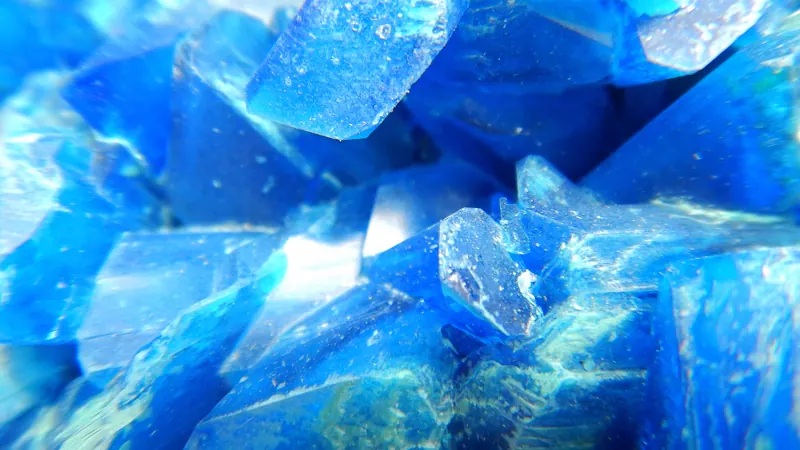
| Appearance | Lyophilised (freeze-dried) powder in a sealed vial. The copper(II) in GHK-Cu can give the powder and its solutions a blue tint. |
| Intended use | Laboratory and research use only |
Component formulas, molecular weights, CAS numbers and compound IDs are PubChem reference values. Quantities are as labelled by the supplier and have not been independently verified. Sources
Store the sealed vial dry, dark and frozen at −20 °C or colder, and let it reach room temperature in a desiccator before opening.S1 A blend is only as stable as its least stable component: TB-500's C-terminal glutamine can deamidate in solution, and the copper complex changes species with pH. Keep reconstituted stock as frozen single-use aliquots and do not refreeze a thawed aliquot.
Because three peptides share one solution, choose a solvent compatible with all of them: water or a near-neutral buffer, free of chelators such as EDTA that would strip copper from GHK-Cu.
The concentration of a stock solution is set by the assay protocol, not by this page. Our guides to reconstituting peptides with bacteriostatic or sterile water and how to store peptides explain the reasoning behind each step.
Purity: not published. Titan Peptides publishes a purity figure only once a certificate of analysis (COA) for the batch has been checked and its compound name, CAS number and sequence match the product. Until that check is complete, no purity figure is shown on this page or in the catalogue.
A COA is available to account holders on request. Our guide on how to read a peptide certificate of analysis explains what to check, and HPLC and mass spectrometry for peptide purity covers how the figures are measured.
Schedule 4 (Poisons Standard).
In the Therapeutic Goods (Poisons Standard—June 2026) Instrument 2026, which commenced on 1 June 2026, BPC-157 is listed in Schedule 4 (prescription-only medicines) and in Appendix D, clause 5, the table of poisons that "must not be possessed by a person without authority".4
In the June 2026 Poisons Standard, TB-500 and thymosin beta 4 each have their own entry in Schedule 4 (prescription-only medicines), and each is also listed in Appendix D, clause 5, which covers poisons that "must not be possessed by a person without authority".4
The TGA's 13 April 2026 safety advisory names BPC-157, TB-500 and GHK-Cu as examples of unapproved peptide products and states that a "research use only" disclaimer does not make supply lawful.5 A blend containing them is not an approved therapeutic good in Australia. See research peptides and Australian law.
GLOW is a trade name for a lyophilised mixture of three research peptides in one vial: BPC-157, GHK-Cu and TB-500. The supplier labels the vial as BPC-157 10 mg, GHK-Cu 50 mg and TB-500 10 mg. Each component keeps its own CAS number and PubChem record.
No. A CAS number identifies a single substance, and GLOW is a mixture. Use the component identities instead: BPC-157 is CAS 137525-51-0, GHK-Cu (prezatide copper) is CAS 89030-95-5 and TB-500 is CAS 885340-08-9.
Liquid chromatography with mass spectrometry separates the components and confirms each by mass: about 1419.5 g/mol for BPC-157, 889.0 g/mol for TB-500 and 340.38 g/mol for the GHK peptide, which may appear with or without its copper. A certificate for a blend should report each component, not a single mass.
Sealed, dry and dark at −20 °C or colder. Warm the vial to room temperature in a desiccator before opening, reconstitute in a solvent compatible with all three components, and keep the solution as frozen single-use aliquots.
A chemical profile of BPC-157: the 15-residue sequence and its identifiers, salt forms, how identity is checked in the laboratory, storage, and its place in the Australian Poisons Standard.
A chemical profile of TB-500, the N-acetylated LKKTETQ fragment of thymosin beta-4: identifiers, how the fragment and the full protein differ, where descriptions disagree, and how identity is checked.
A chemical profile of GHK-Cu, the copper(II) complex of the tripeptide glycyl-L-histidyl-L-lysine: how the copper is bound, the 1:1 and 2:1 forms, the names in use, bench handling and regulation.
Listed by title and journal for identification only. Titan Peptides does not summarise or rely on the findings of these papers.